A Dakar race car with enormous horsepower sounds like the perfect weapon for crossing the desert. In reality, adding more power is only useful if the rest of the vehicle can survive what that power does to it.
Dakar competitors spend hours racing across dunes, rocks, fast tracks, deep sand, and rough terrain. A vehicle may repeatedly absorb huge suspension impacts while its engine, transmission, cooling system, tyres, and electronics operate under continuous stress.
Unlike a short circuit race, a small mechanical weakness can eventually become a stage-ending problem hundreds of kilometres later.
That is why Dakar vehicle design prioritizes reliability over peak power.
Toyota’s GR DKR Hilux Evo, for example, produces a regulated 264 kW from its twin-turbo V6, yet Toyota repeatedly describes quality, durability, and reliability as central development targets.
FIA rules also control Ultimate-class engine performance rather than encouraging an unrestricted horsepower race.
Winning Dakar engineering is therefore less about creating the most powerful machine possible and more about building one that can keep producing competitive performance day after day.
1. Dakar Rewards Performance Across Thousands of Kilometres
Peak power is impressive when measured on a dyno.
Dakar victories are measured after days of punishment.
The event combines long timed specials with demanding liaison distances and can include marathon stages where normal team assistance disappears.
Dakar’s official format states that during marathon stages competitors cannot receive outside assistance from team members, so they may have to manage problems themselves until normal support returns.
That changes engineering priorities dramatically.
An engine that produces another 30 horsepower but runs closer to its thermal or mechanical limits might deliver a small advantage on a fast section. If that extra stress reduces component life, the trade becomes difficult to justify.
Designers instead want repeatable performance.
The ideal Dakar powertrain should deliver strong torque in dunes, reliable acceleration on fast tracks, and stable output after hours of operation.
In other words, engineers are building for sustained speed rather than short bursts of maximum output.
2. FIA Regulations Reduce the Value of Chasing Maximum Horsepower
Modern Ultimate-class competition also prevents manufacturers from turning Dakar into a simple engine-power contest.
Toyota’s current Hilux Evo specification lists 264 kW, or around 354 hp, and states that turbo boost is controlled through an FIA reference power curve.
That means teams cannot simply increase boost indefinitely and overpower their rivals.
Once available engine performance is controlled within the regulatory framework, engineers gain more by improving how effectively that power reaches the ground.
Throttle response, torque delivery, traction, gearing, driveline efficiency, weight distribution, and cooling suddenly matter enormously.
A vehicle producing slightly less theoretical peak output may still be faster through a Dakar stage if the driver can use its torque more predictably.
This makes reliabilty engineering even more valuable.
When horsepower differences are controlled, avoiding mechanical failures becomes one of the clearest ways to protect overall performance.
3. More Power Creates More Heat
Horsepower never arrives for free.
More engine output generally means more fuel being burned, greater thermal loads, and additional heat that must be managed by cooling systems.
In Dakar conditions, that can become a serious engineering problem.
Cars sometimes travel quickly enough to push large amounts of cooling air through radiators. In deep dunes, however, the engine may be working extremely hard while vehicle speed drops dramatically.
Sand and dust can further reduce airflow.
Dacia’s development of the Sandrider shows how much attention teams give this problem.
For its 2026 car, Dacia revised radiator grilles, added filtration to reduce sand entering a cooling fan, upgraded fan motors, repositioned the airbox, and introduced a water-cooled DC-DC unit.
Those changes specifically targeted cooling performance and reliability.
Increasing peak engine power without increasing cooling capacity would simply push the entire system closer to failure.
Controlling temperautre is therefore often more useful than finding another few horsepower.
4. The Drivetrain Has to Absorb Brutal Torque Loads
The engine is only the beginning of the power path.
Torque then travels through the clutch, sequential gearbox, differentials, driveshafts, joints, and finally the wheels.
Every one of those components experiences violent loads during Dakar competition.
Imagine a wheel spinning quickly in sand before suddenly finding grip. Or a car landing from a jump while the driver remains on the throttle.
The shock through the driveline can be enormous.
More engine torque can increase those stresses.
That is why Dakar engineering teams pay close attention to drivetrain durability rather than simply asking how much power the engine can make.
Dacia’s 2026 development program included a redesigned front driveshaft spline and changes intended to prevent excessive drivetrain loading. Toyota similarly uses a proven six-speed sequential transmission and limited-slip differentials within its Hilux package.
A drivetrain capable of surviving two weeks is worth far more than one capable of handling huge power for one spectacular afternoon.
5. Suspension Reliability Can Matter More Than Engine Performance
A Dakar vehicle cannot use its horsepower if one wheel is no longer attached correctly.
That sounds obvious, yet suspension and wheel-related failures repeatedly demonstrate how small mechanical components can determine the entire rally.
During Dakar 2026, Henk Lategan lost more than four hours after a small bolt associated with the wheel assembly failed.
He explained that the car carried many replacement components for parts deliberately designed to be easier to repair, but this particular failure caused the wheel bearing assembly to come apart.
That example captures the Dakar engineering philosophy perfectly.
Vehicles often include components that effectively act as mechanical “fuses.” Engineers would rather have a predictable, replaceable part fail than allow an impact to transfer damage into a larger and harder-to-repair assembly.
Ford takes a similar durability-focused approach with the Raptor T1+, using independent double-wishbone suspension, sophisticated external-bypass dampers, and up to 350 mm of wheel travel.
Absorbing terrain reliably is often more valuable than reaching a higher top speed.
6. Dakar Cars Are Designed Around Repairability
Circuit racing cars can return to sophisticated garages after short sessions.
Dakar competitors sometimes have to solve problems in the middle of nowhere.
That means engineers need to think about how quickly components can be inspected, removed, and replaced.
Accessibility matters.
A part that is incredibly strong but takes three hours to replace may not always be superior to a slightly heavier component designed for a fast field repair.
Teams also decide which spare parts must travel inside the race car.
That adds weight, so crews cannot carry everything.
Lategan’s 2026 experience highlighted this challenge clearly: his Toyota carried spares for several suspension and wheel-related items considered likely or practical to replace, but not for the unusual bolt failure that eventually cost hours.
Dakar design therefore involves probability management.
Engineers ask which components are most likely to fail, which can reasonably be repaired during a stage, and which failures must be prevented almost completely through stronger design.
That approach has very little to do with peak horsepower.
7. Reliability Development Happens Long Before the Dakar Starts
Manufacturers do not discover durability during the rally itself.
They spend thousands of kilometres trying to break things beforehand.
Toyota reported nearly 30,000 kilometres of racing and testing during its 2023 development work, including additional running in the Kalahari and Namib deserts.
The program specifically targeted quality, durability, reliability, suspension improvements, and cooling redundancy.
Dacia took a similar approach before its first Dakar campaign.
Its technical team worked on engine reliability, cooling performance, fan-control electronics, and the expected service life of individual components.
Technical director Philip Dunabin explained that the team evaluated how long parts would survive so it could prepare enough components to reach the end of Dakar with minimal problems.
This is endurance engineering in its purest form.
Teams are not merely testing whether a component works.
They want to know how long it works, how it deteriorates, what warning signs appear, and when it should be replaced before failure.
8. Preventive Maintenance Is Part of Vehicle Performance
Reliability is not created only by strong components.
It also depends on knowing when those components are approaching their limits.
Dakar even provides competitors with services designed around preventive maintenance. Its Service Center offers lubricant analysis that can help teams monitor oil ageing and degradation, supporting decisions about oil changes and component replacement schedules.
Factory teams take this philosophy much further.
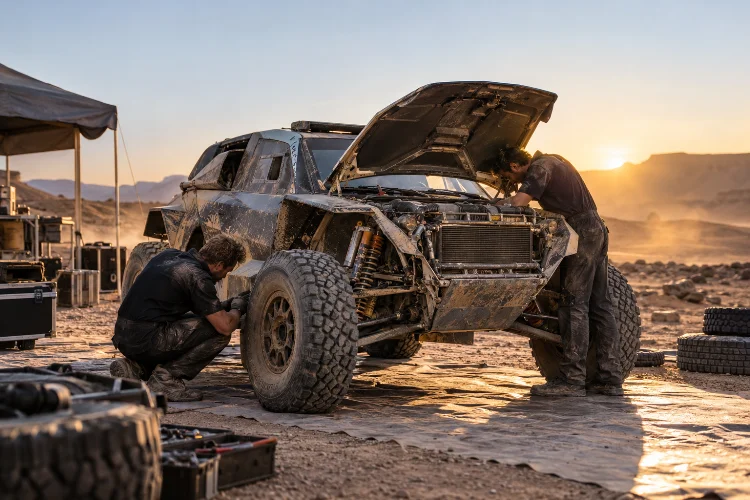
After every normal stage, mechanics inspect the vehicle for cracks, leaks, loose fasteners, damaged suspension parts, drivetrain wear, cooling issues, and electronic faults.
Many parts may be replaced before they actually fail.
From a traditional road-car perspective, that can look excessive.
From a Dakar perspective, it is smart risk management.
The objective is not maximum component life. It is maximum probability of finishing every stage without an unexpected failure.
That distinction explains why durabilty and preventive maintenance become competitive advantages.
9. Marathon Stages Make Reliability Even More Valuable
Marathon stages expose any weakness that teams managed to hide during normal servicing.
External assistance is heavily restricted, so a vehicle that normally depends on extensive overnight repairs suddenly has to survive without them.
Drivers naturally adjust their pace, but engineering determines how much margin they have.
Nasser Al-Attiyah demonstrated this thinking during the 2026 Dakar when he accepted losing time during a marathon stage rather than taking unnecessary risks while navigation and terrain were difficult.
Completing the section without problems mattered more than forcing an overtake.
Vehicle design follows the same philosophy.
A car with slightly less explosive performance but stronger cooling, dependable suspension, protected driveline components, and fewer weak points gives the driver greater confidence in these stages.
Peak power might help win one acceleration contest.
Reliability helps protect an entire Dakar campaign.
10. The Best Dakar Car Is the One That Keeps Moving
Dakar results repeatedly demonstrate how quickly mechanical problems overwhelm raw pace.
During the 2026 event, Lategan suffered power-steering problems, punctures, and later the wheel-component failure that effectively ended his challenge.
Meanwhile, the final rally report highlighted how mechanical trouble reshaped the fight near the front despite several competitors having clear stage-winning speed.
That is why engineers think differently about performance.
Horsepower is useful only when the suspension, transmission, tyres, electronics, cooling system, steering, and wheel assemblies remain functional.
A car parked beside the track has zero useful horsepower.
The fastest overall package is therefore often the vehicle with the best balance of speed and effeciency, not the most extreme engine specification.
Dakar vehicles prioritize reliability over peak power because the rally punishes every mechanical weakness eventually.
Modern regulations already keep engine performance within controlled boundaries, while manufacturers must manage far more complicated challenges: heat, drivetrain shock, suspension impacts, dust, tyre loads, repairability, and marathon stages without normal assistance.
That pushes teams toward a different definition of performance. A successful Dakar car must deliver strong power repeatedly, remain cool, absorb punishment, allow quick repairs, and reach the next bivouac in competitive condition.
So when comparing Dakar machines, look beyond horsepower figures. Cooling redundancy, reinforced suspension, component life, and ease of maintenance often reveal much more about whether a vehicle can actually win.
In the Dakar, the best engine is not necessarily the most powerful one. It is the one still running strongly when the finish finally appears.