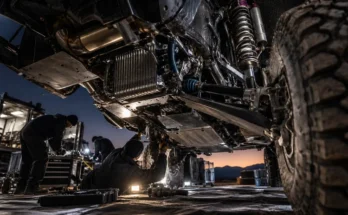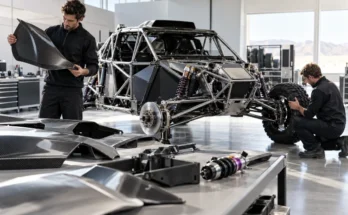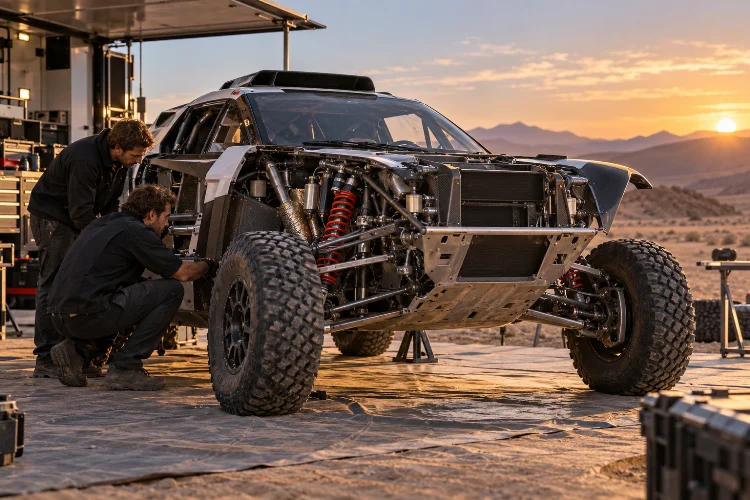
A Dakar Rally car might look vaguely like an SUV or pickup from a distance, but underneath the bodywork it is an entirely different machine.
These vehicles are designed to hit rough terrain at remarkable speeds, climb enormous dunes, survive deep sand, absorb repeated landings, and continue racing for hundreds of kilometres before reaching the bivouac.
That combination makes Dakar engineering very different from building a circuit car, where smooth asphalt, predictable corners, and regular pit access shape the design.
Modern Ultimate-class prototypes are purpose-built around FIA cross-country regulations.
Current examples such as the Ford Raptor T1+, Dacia Sandrider, and Toyota GR DKR Hilux Evo use tubular structures, long-travel suspension, large off-road tyres, powerful engines, and specialised cooling systems.
Understanding how Dakar Rally vehicles are engineered for extreme desert racing means looking beyond horsepower. Reliability, suspension control, cooling, repairability, weight distribution, and occupant protection are just as important as outright speed.
1. The Chassis Has to Be Strong Without Becoming Too Heavy
A Dakar car needs enormous structural strength.
Instead of depending on a normal production-car platform, leading Ultimate prototypes typically use a tubular spaceframe.
This creates a rigid safety structure while allowing engineers to position the engine, fuel system, suspension mounting points, crew, spare wheels, and other components exactly where they want them.
The Ford Raptor T1+, for example, uses a T45 steel spaceframe with carbon-fibre body panels. The Dacia Sandrider similarly combines a tubular chassis with carbon-fibre bodywork.
The exterior panels are therefore not doing the same structural job they perform on many production vehicles.
Their main purpose is aerodynamics, protection, cooling management, and visual identity.
This approach also makes the vehicle easier to optimise around weight distribution.
Engineers want heavy components positioned low and centrally wherever possible because excessive weight at the front, rear, or high above the ground can make the car harder to control across dunes and fast broken tracks.
The challenge is finding enough strenght without carrying unnecessary mass.
2. Long-Travel Suspension Is the Heart of a Dakar Car
If one component defines a modern Dakar prototype, it is probably the suspension.
These vehicles repeatedly encounter rocks, holes, dune compressions, jumps, and surfaces that would destroy conventional road-car suspension within minutes.
The Ford Raptor T1+ uses independent double-wishbone suspension front and rear with sophisticated adjustable dampers and up to 350 mm of wheel travel.
Dacia lists the same 350 mm suspension travel figure for the Sandrider, while Toyota’s GR DKR Hilux Evo also uses double wishbones with 350 mm of travel.
That huge movement allows a wheel to rise and fall dramatically while helping the body remain comparatively controlled.
But suspension travel alone is not enough.
Dampers must manage energy repeatedly without overheating or losing effectiveness. Teams tune compression and rebound characteristics so the car can absorb violent impacts while remaining stable enough for accurate steering at speed.
Too soft and the car can bottom out or feel uncontrolled. Too stiff and impacts are transmitted into tyres, chassis components, and the crew.
Good suspention engineering is therefore a balance between comfort, traction, control, and survival.
3. Large Tyres Become Part of the Suspension System
Dakar tyres do much more than provide grip.
Their large diameter and substantial sidewalls act as another layer of suspension between the terrain and the vehicle.
Modern top-class rally-raid prototypes commonly use 37-inch tyres on 17-inch wheels. Ford specifies that combination for the Raptor T1+, while Dacia lists 37-inch BFGoodrich tyres for the Sandrider. Toyota’s Hilux Evo uses the same general 37-inch and 17-inch format.
The large footprint helps in soft sand because the tyre can distribute vehicle weight across a broader area.
Tyre pressure becomes another tuning tool. Reducing pressure can improve flotation and traction in soft dunes, while higher pressures may provide better protection against impacts in rocky terrain.
The compromise is difficult.
Very low pressure may increase the chance of tyre damage or excessive heat. High pressure can reduce grip and make the vehicle harsher over irregular surfaces.
Drivers and engineers therefore treat tyre pressure as part of the stage strategy rather than a simple fixed setting.
4. Engines Need Usable Torque More Than Spectacular Peak Power
Dakar vehicles are powerful, but headline horsepower does not tell the whole story.
What matters is delivering controllable performance across sand, rocky climbs, fast tracks, and low-speed technical sections.
The Dacia Sandrider uses a 3.0-litre twin-turbo V6 producing a listed 265 kW, or around 360 hp, with 539 Nm of torque.
Toyota’s GR DKR Hilux Evo uses a production-derived twin-turbo V6 with 264 kW and 620 Nm, while Ford chose a Coyote-based 5.0-litre V8 for the Raptor T1+.
Different manufacturers therefore reach the same problem with different engine philosophies.
In dunes, predictable torque delivery helps drivers maintain momentum without creating unnecessary wheelspin. On fast desert tracks, the engine must sustain high loads for long periods without overheating.
Lubrication also matters when the car is climbing, descending, landing, or leaning at extreme angles. Ford, for example, specifically engineered the Raptor T1+ with a dry-sump oil system for rally-raid conditions.
The target is not simply maximum power.
It is dependable power for hours.
5. Cooling Systems Are Designed for Heat, Sand, and Low-Speed Loads
Cooling a Dakar car is much harder than cooling a racing vehicle travelling continuously at high speed on clean asphalt.
Desert heat is only part of the problem.
Soft dunes can force the engine to work extremely hard while vehicle speed – and therefore cooling airflow – drops. Dust and sand can also affect airflow through heat exchangers.
That means teams engineer generous cooling capacity and carefully manage how air enters and exits the body.
Toyota specifically highlighted an updated cooling package with increased redundancy when developing the GR DKR Hilux Evo, while also relocating its air-conditioning unit to improve efficiency.
Redundancy matters because Dakar stages are long.
A minor cooling problem that might be manageable during a short race can become catastrophic after several hours in the desert.
Engine coolant, gearbox oil, differential temperatures, and cabin conditions all need attention.
A vehicle that is fast for 50 kilometres but cannot control its temperatue for 400 kilometres is not a competitive Dakar machine.
6. The Drivetrain Is Built for Repeated Shock Loads
Producing torque is one thing. Delivering it to the ground for thousands of kilometres is another.
Dakar drivetrains endure constant shock.
A wheel may leave the ground while spinning quickly, then suddenly regain traction on landing. Deep sand creates high continuous loads, while rocks can send sharp impacts through the driveline.
That is why robust sequential transmissions, differentials, driveshafts, and joints are essential.
Toyota’s Hilux Evo, for example, uses a six-speed sequential gearbox and limited-slip differentials at the front, centre, and rear. Dacia also uses a six-speed sequential transmission with four-wheel drive.
Four-wheel drive provides valuable traction when climbing dunes or accelerating across loose terrain.
However, every additional component also adds weight and another possible failure point.
Engineers therefore design drivetrains around durablity as much as performance.
If a component can survive slightly more abuse at the cost of a small weight penalty, that may be a worthwhile trade during a two-week rally.
7. Ground Clearance and Geometry Help Cars Attack Huge Obstacles
A Dakar car needs enough clearance to cross terrain that would strand a conventional vehicle almost immediately.
Ford lists approximately 400 mm of ground clearance for the Raptor T1+, together with an approach angle exceeding 70 degrees.
Those numbers matter when attacking steep dunes or crossing broken ground.
Short overhangs help prevent the nose or rear bodywork from digging into sand. A long enough wheelbase improves stability, but engineers cannot make it so long that the vehicle struggles to crest sharp dunes.
Dacia’s Sandrider, for example, uses a 3,000 mm wheelbase with relatively short front and rear overhangs.
Underbody protection is equally important.
Rocks can hit critical components with enormous force, so vulnerable mechanical systems need protection without trapping excessive heat or adding too much weight.
This is another example of how almost every Dakar design choice involves compromise.
8. Fuel Capacity Turns Packaging Into an Engineering Puzzle
Long stages require significant fuel capacity.
Some T1+ Dakar competitors list tanks around 500 litres, while Toyota has specified a 540-litre FT3 safety-cell fuel tank for its Hilux Evo.
Dakar’s own 2026 competitor listings also show some Ultimate prototypes carrying approximately 500–540 litres depending on the vehicle.
That creates a major packaging challenge.
Hundreds of litres of fuel represent significant mass, particularly early in a stage. Engineers therefore care enormously about tank location.
The fuel needs to sit securely inside the structure while minimising changes to handling as the tank empties.
Teams must also find room for spare wheels, tools, navigation equipment, hydraulic systems, cooling components, and safety equipment.
A Dakar car is effectively a high-speed racing machine and a self-contained survival package at the same time.
Every centimetre matters.
9. Safety Engineering Has to Prepare for Violent Impacts
The same suspension that allows Dakar cars to travel quickly over extreme terrain also means crashes can happen at substantial speeds.
FIA cross-country vehicles are therefore governed by dedicated safety requirements alongside their category-specific technical regulations. The FIA publishes separate provisions covering cross-country safety equipment as well as the Ultimate prototype rules.
The tubular structure creates a protective survival space around the driver and navigator.
Racing seats, harnesses, helmets, fire-protection systems, fuel-cell requirements, and other safety equipment form additional layers around that structure.
Designers also have to consider crew fatigue.
Air conditioning may sound luxurious in a race car, but cabin heat can affect concentration and physical performance over several hours. Toyota’s decision to refine the location of its air-conditioning hardware shows how even crew comfort becomes part of engineering efficiency.
At Dakar, safety and performance are often closely connected.
A driver who remains cooler and less exhausted is more likely to make good decisions late in a stage.
Dakar Rally vehicles are extraordinary because they are engineered for far more than speed.
A competitive machine needs a strong tubular chassis, huge suspension travel, large tyres, reliable power, effective cooling, durable four-wheel-drive hardware, substantial fuel capacity, and serious occupant protection.
Every component must continue working while the vehicle absorbs impacts, crosses dunes, fights heat, and covers hundreds of timed kilometres.
That is why Dakar engineering is fundamentally about balance. More power means little if the drivetrain fails, while massive suspension travel is useless without controlled damping and reliable tyres.
The next time you see a Dakar car flying across a dune, look beyond the dramatic jump. The impressive part is not simply that it can land once – it is that engineers expect it to keep doing so for thousands of kilometres and still reach the finish.