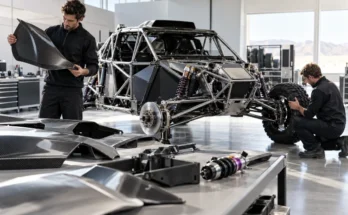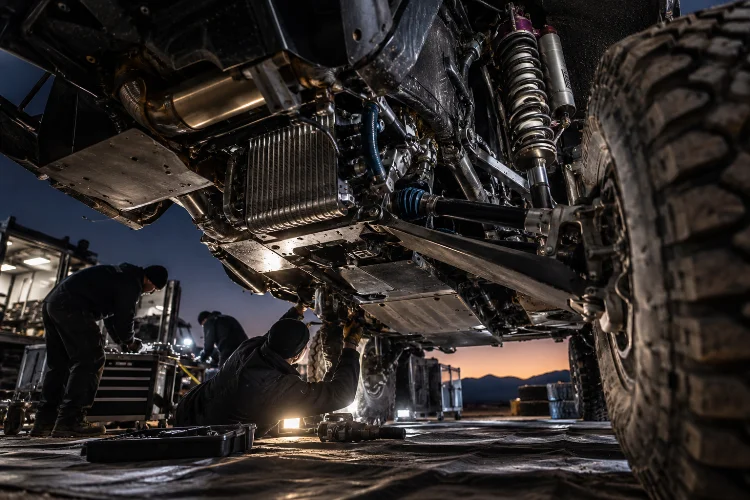
A competitive Dakar Rally car has to solve problems that rarely exist together in conventional motorsport.
It needs enough speed to race across open desert, suspension capable of absorbing violent impacts, a drivetrain strong enough for repeated shock loads, and cooling systems that still work when deep sand reduces vehicle speed.
Then everything has to survive day after day without making the car unnecessarily heavy. That is what makes the advanced engineering challenges behind competitive Dakar Rally cars so interesting.
Modern Ultimate-class machines such as the Toyota GR DKR Hilux Evo, Ford Raptor T1+, and Dacia Sandrider use tubular structures, sophisticated long-travel suspension, four-wheel drive, large off-road tyres, and purpose-built component layouts.
Current FIA rules provide the technical framework for these prototype cross-country vehicles rather than allowing completely unrestricted designs.
But meeting the regulations is only the beginning. The real challenge is building a machine that remains fast after thousands of kilometres of heat, vibration, sand, rocks, and hard landings.
1. Suspension Must Absorb Impacts Without Losing Control
Suspension is one of the hardest Dakar engineering problems because it has to handle two very different jobs.
First, it must absorb huge vertical movement when the car crosses holes, rocks, dune compressions, and jumps. Second, it must keep the vehicle stable enough for the driver to maintain accurate steering at high speed.
Modern Ultimate cars commonly operate with enormous suspension travel. Toyota’s GR DKR Hilux Evo lists 350 mm of travel at both ends, while the Ford Raptor T1+ also offers up to 350 mm using independent double wishbones and sophisticated external-bypass dampers.
More travel alone does not solve the problem.
Dampers convert suspension movement into heat. Over hundreds of kilometres of rough terrain, controlling that theraml load becomes critical because overheated dampers can lose consistency.
Engineers therefore tune spring rates, compression, rebound, reservoir capacity, and bypass characteristics to keep the car controlled throughout a long stage rather than only for a few spectacular jumps.
2. Structural Strength Has to Survive Repeated Fatigue
A Dakar chassis rarely fails because of one perfectly predictable load.
The more difficult problem is accumulated fatigue.
Thousands of smaller impacts continuously load suspension mounts, welds, chassis tubes, brackets, and drivetrain supports. A component that survives one major landing may still develop fatigue after days of vibration and repeated stress.
That is why top prototypes use carefully engineered tubular structures.
Ford’s Raptor T1+ is based around a T45 steel spaceframe with carbon-fibre body panels, while Dacia specifies a tubular chassis and carbon-fibre body for the Sandrider. Toyota also uses a tubular frame beneath its composite Hilux-style bodywork.
This allows engineers to concentrate structural material around critical load paths instead of making the entire vehicle equally heavy.
The difficult part is predicting where fatigue will appear after several thousand kilometres.
Simulation helps, but real testing remains essential because Dakar terrain produces irregular loads that are extremely difficult to reproduce perfectly on a computer.
3. Cooling Becomes Hardest When the Car Is Moving Slowly
A Dakar engine can produce impressive power while the vehicle is travelling quickly across an open track.
Deep sand creates a much nastier engineering situation.
The engine may be producing heavy load to maintain momentum, yet vehicle speed is relatively low. That means less natural airflow through radiators at exactly the moment cooling demand becomes high.
Sand and dust can make matters worse by affecting ducts, filters, fans, and heat exchangers.
Toyota specifically redesigned the cooling package of the Hilux Evo with additional redundancy during its development program. The team accumulated nearly 30,000 kilometres of racing and testing in 2023 while refining cooling, suspension, reliability, and other systems.
Engineers therefore design around worst-case conditions, not ideal airflow.
Engine coolant is only part of the problem. Transmission oil, differentials, dampers, electronics, and the cabin all generate or absorb heat.
A car that is extremely fast for 50 kilometres but overheats after 200 is not properly engineered for Dakar.
4. The Drivetrain Has to Survive Violent Torque Reversals
Four-wheel drive provides enormous traction in loose terrain, but getting torque to four tyres reliably is complicated.
Dakar drivetrains experience loads that change incredibly quickly.
A wheel may spin freely after leaving the ground and then regain grip almost instantly when the vehicle lands. The resulting torque spike travels through driveshafts, joints, differentials, transmission components, and wheel assemblies.
Repeated thousands of times, those shocks become a serious durability problem.
Toyota uses a six-speed sequential transmission with limited-slip front, centre, and rear differentials in the Hilux Evo. Dacia’s current Sandrider also combines four-wheel drive with a six-speed sequential gearbox.
Engineers could simply make every drivetrain component larger, but that adds weight and rotating mass.
Instead, they search for an intelligent strength margin.
The component needs enough durablity to survive severe load cycles without becoming so heavy that acceleration, suspension response, or efficiency suffers.
5. Weight Is Really a Packaging Problem
Dakar engineers do not only ask how much a car weighs.
They ask where that weight sits.
Toyota’s 2025 GR DKR Hilux Evo was listed at the 2,010 kg FIA-regulated minimum dry weight while carrying architecture capable of supporting a 540-litre safety fuel cell, 37-inch tyres, and extensive rally-raid hardware.
Once fuel, crew, tools, and spare wheels are added, operating mass changes considerably.
Heavy components therefore need careful placement.
Fuel positioned too high can raise the centre of gravity. Spare tyres placed too far rearward may alter handling. Cooling equipment, batteries, drivetrain parts, tools, and safety systems all compete for limited space.
The difficulty becomes even greater because fuel mass decreases throughout a stage.
Engineers want the car to remain predictable whether the tank is close to full or significantly lighter.
Good packging is therefore just as important as simply reducing kilograms.
6. Dust Protection Cannot Restrict the Air the Car Needs
Desert racing produces another contradiction: the vehicle needs huge amounts of air, but the environment is full of material engineers want to keep outside.
The engine needs clean intake air.
Radiators need cooling airflow.
Crew ventilation also matters.
Unfortunately, sand and fine dust can damage engines, clog filters, reduce cooling effectiveness, contaminate components, and create problems inside electrical systems.
Engineering an intake therefore becomes a balancing act between filtration and restriction.
A very restrictive filter may protect the engine but reduce airflow. A system designed only for maximum breathing may allow contamination during long dusty stages.
Bodywork and duct design also matter.
Air needs to reach the correct heat exchangers without collecting too much sand or creating unnecessary aerodynamic drag.
This is one reason Dakar bodywork is functional rather than purely cosmetic. Scoops, vents, panels, and duct locations all contribute to keeping important systems alive.
7. Large Tyres Create Benefits and New Engineering Loads
Current leading Ultimate cars commonly use 37-inch off-road tyres on 17-inch wheels.
Toyota, Ford, and Dacia all list this general combination on their rally-raid machines.
Large tyres provide excellent ground clearance and flotation in sand, while their substantial sidewalls add another layer of impact absorption.
But they also create engineering problems.
A large tyre and wheel assembly has significant mass. Engineers have to control that unsprung weight while ensuring wheel hubs, bearings, suspension arms, and steering components survive the loads generated by such a large rotating assembly.
Tyre pressure creates another compromise.
Lower pressure improves flotation in soft dunes but can increase sidewall movement and vulnerability to certain types of damage. Higher pressure offers different protection on rocky surfaces but may reduce compliance and grip.
The tyre therefore becomes part of the suspension, traction, and reliability strategy simultaneously.
8. Reliability and Serviceability Must Be Designed Together
Making a component durable is only half of the Dakar problem.
Engineers also need to consider what happens when it breaks.
During a conventional race, damaged parts can often be changed in a fully equipped pit or workshop. Rally-raid crews may encounter problems hundreds of kilometres from assistance.
Components that can be accessed and replaced quickly therefore have strategic value.
A design that saves 500 grams but requires dismantling half the vehicle for replacement may be a poor Dakar solution.
This also influences the spare parts carried inside the car.
Crews cannot bring everything, so engineering teams identify components that are vulnerable, realistically replaceable, and important enough to justify additional onboard weight.
Dakar regulations also include periods where assistance is restricted, making self-reliance even more valuable. The event’s current regulations work alongside FIA sporting and technical requirements to define what teams can do during competition.
Serviceability is therefore not an afterthought.
It is another form of performance.
9. Engineers Have to Develop Within Tight Regulations
Unlimited engineering might actually make Dakar design easier in some ways.
Real teams must optimise inside regulations.
The FIA’s current Appendix J Article 285 governs Ultimate prototype cross-country cars, while sporting regulations identify T1+ as 4×4 prototype vehicles complying with the relevant Ultimate requirements.
Rules influence dimensions, engine performance, safety systems, suspension architecture, vehicle mass, and many other areas.
Toyota, for example, lists its twin-turbo V6 as operating with boost limited according to an FIA reference power curve. Its published output is 264 kW with 620 Nm of torque.
That shifts engineering competition away from simply adding unlimited engine power.
Teams search for advantages in cooling, control systems, suspension tuning, weight distribution, reliability, aerodynamics, and component life.
Small improvements become extremely important when everyone operates inside the same regulatory framework.
Competitive Dakar Rally cars are engineering compromises built for one of motorsport’s least forgiving environments.
Their suspension must absorb enormous impacts without overheating, the chassis must resist fatigue without excessive weight, and the drivetrain must survive repeated torque shocks.
Cooling systems battle heat and sand, while tyres, fuel, spare parts, and safety equipment create complicated weight and packaging problems.
The impressive part is not that engineers solve one of these challenges. They have to solve all of them inside strict regulations while keeping the car fast enough to fight for stage victories.
So when you watch a Dakar prototype attack dunes or rocky tracks, look beyond horsepower. The real engineering achievement is a machine that can perform at that level for thousands of kilometres – and still arrive at the finish ready to race.