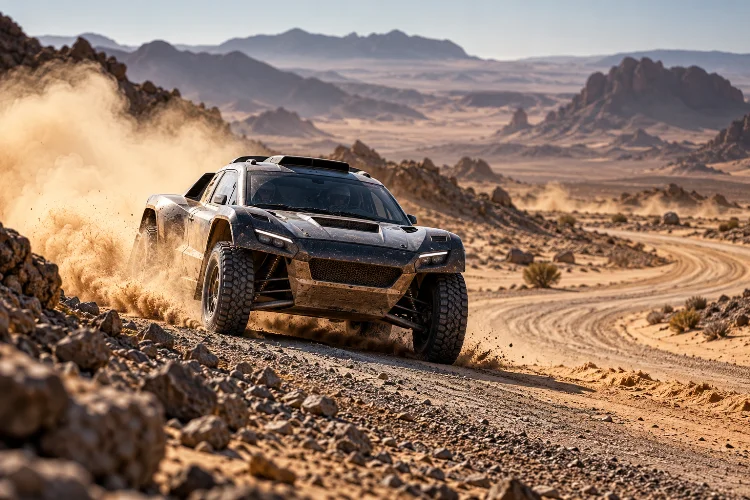
Braking a Dakar Rally car is not simply about pressing the pedal as hard as possible before a corner.
At high speed, drivers may approach a braking zone on firm gravel, cross loose sand while slowing, hit a compression, and discover rocks near the corner entry – all within a few seconds.
The amount of grip available can change before the car has even finished decelerating. That makes braking one of the most adaptable skills in rally raid.
Modern Dakar cars have serious stopping hardware. Ford’s Raptor T1+, for example, uses 355 mm ventilated brake discs with six-piston monoblock calipers front and rear, alongside 37-inch tyres and up to 350 mm of suspension travel.
But hardware alone cannot solve an unpredictable surface.
Understanding how braking technique changes on high-speed Dakar Rally stages means looking at braking pressure, weight transfer, terrain reading, brake release, temperature, navigation, and mechanical risk.
Elite drivers do not simply brake later. They brake in a way that keeps the vehicle balanced and ready for whatever comes next.
1. High Speed Requires Earlier Decisions, Not Just Harder Braking
The faster a Dakar car travels, the more important preparation becomes.
At very high speed, a driver cannot wait until the last second to discover whether the braking surface is firm gravel or loose sand. They need to read the terrain early and decide how much grip will probably be available before committing to heavy pedal pressure.
This is different from circuit racing.
On a racetrack, braking points can be repeated lap after lap. Dakar drivers may see a particular corner only once, often while following roadbook instructions and dealing with dust or changing terrain.
That encourages a slightly different mindset.
Rather than always chasing the latest possible braking point, the driver may brake a little earlier and create more control over the final approach.
Edgar Canet described this approach after winning the 2026 Dakar prologue on two wheels: he followed the roadbook closely, braked before the dangers, avoided unnecessary risks, and still produced the fastest time.
The lesson applies across categories. Controlled preparation can be faster than last-second reactions.
2. Initial Brake Pressure Depends on Surface Grip
Firm ground allows stronger initial braking because the tyres can transmit more longitudinal force.
Loose surfaces require more care.
If a driver suddenly applies maximum brake pressure on gravel covered with loose stones, the tyres may begin sliding before meaningful deceleration occurs. Once the tyre is sliding, steering control also becomes harder.
Elite drivers therefore adjust their initial pedal input.
On firm sections, they may apply pressure quickly and aggressively. On loose terrain, the pressure often builds more progressively so the tyres remain close to their useful grip range.
The exact technique can change within the same braking zone.
A driver might begin braking on firm gravel, then slightly reduce pressure when the vehicle crosses loose sand before increasing it again when the surface improves.
This constantly changing braking rythym is one reason Dakar driving requires such strong feel through the pedal, steering, and chassis.
3. Braking Moves Weight Toward the Front Axle
Every braking event changes vehicle balance.
As the car decelerates, load transfers toward the front tyres. That extra front load can help them generate grip, but it also reduces load at the rear.
Too much forward transfer on loose ground can make the rear unstable.
If the driver then turns sharply while maintaining heavy brake pressure, the back of the car may begin rotating faster than intended.
High-level Dakar drivers control this by gradually releasing the brakes as steering input increases.
This keeps the transition from braking to turning smoother and avoids asking the tyres to perform too many tasks at once.
Long-travel suspension adds another dimension. A modern T1+ vehicle may have around 350 mm of suspension movement, which helps absorb terrain but also means engineers must carefully control pitch and chassis movement.
Ford’s Raptor T1+ combines this travel with adjustable external-bypass dampers designed for control and durability over extreme surfaces.
The driver works with that movement rather than fighting it.
4. Brake Release Can Matter More Than the Initial Pedal Hit
Many drivers focus on how hard professionals brake.
The release is just as important.
If the driver keeps heavy pressure too long, the front tyres may be overloaded when steering begins. Releasing too quickly can suddenly move weight rearward and reduce front grip just as the car needs to turn.
Elite drivers release brake pressure progressively.
This allows the vehicle to transition from straight-line deceleration into cornering without a dramatic change in balance.
On a loose high-speed stage, this smooth release can be particularly valuable because grip is already limited.
The car remains calmer, which means fewer steering corrections and a cleaner line through the corner.
A controlled brake release also helps the driver identify how the surface is behaving.
If the vehicle begins rotating naturally, less steering may be needed. If the front tyres start washing wide, the driver knows they may have carried too much braking load into the turn.
Good braking is therefore not one action.
It is a sequence.
5. Rocks Change the Goal From Maximum Deceleration to Vehicle Protection
High-speed Dakar stages often contain sections where the safest braking technique suddenly becomes the fastest long-term strategy.
Rocks are a perfect example.
Braking heavily just before hitting a large rock transfers more load onto the front axle. If the front tyre then strikes the obstacle, it is dealing with both braking force and a major vertical impact.
That can increase the risk of tyre or wheel damage.
Experienced drivers may instead complete more of their braking before the roughest section, reduce pedal pressure across the obstacle, and then continue slowing afterward if necessary.
Lucas Moraes described exactly this broader risk-management philosophy during the fast opening stage of Dakar 2026.
He deliberately slowed through rocky and narrow sections because completing the stage cleanly and preserving the car for the following day mattered more than attacking every kilometre.
Nasser Al-Attiyah made a similar point on another rocky stage, noting that competitors could effectively lose everything if they made a serious mistake among the rocks.
Sometimes the best braking point is the one that keeps the tyre alive.
6. Drivers Avoid Braking Hard While the Suspension Is Unsettled
A Dakar car is frequently airborne, partially unloaded, or rapidly moving through its suspension travel.
Heavy braking during those moments can produce unpredictable results.
If the wheels become lightly loaded over a crest, they cannot generate normal braking force. When the vehicle lands, grip can return suddenly while the driver is still asking for substantial deceleration.
That can destabilize the chassis.
Elite drivers therefore anticipate crests and large compressions.
They may complete most braking before the crest, reduce pedal pressure while the vehicle becomes light, then continue slowing once all four tyres are properly loaded again.
The same idea applies to extremely rough sections.
Braking while the suspension is repeatedly hitting its working range can create large fluctuations in tyre load. A slightly more conservative entry can keep the car much more consistant.
This does not mean professional drivers avoid braking on rough ground entirely.
They simply recognize that a tyre cannot provide its maximum braking grip when it is barely touching the ground.
7. Brake Temperature Matters Across Long Fast Stages
One huge braking event is rarely the biggest Dakar challenge.
Repeating braking events for hundreds of kilometres is.
Ventilated discs and multi-piston calipers are designed to handle serious thermal loads. Ford’s Raptor T1+ uses 355 mm ventilated Alcon discs and six-piston calipers on both axles, illustrating the scale of braking hardware required in a top-level rally-raid car.
Still, no braking system has unlimited thermal capacity.
Repeated heavy braking converts kinetic energy into heat. If temperatures rise too far, brake performance can become less predictable and component wear increases.
Drivers therefore avoid unnecessary brake use.
Instead of accelerating aggressively toward every corner and then braking excessively, a smooth driver may lift slightly earlier and carry a more natural flow through sections where maximum attack offers little benefit.
That helps control temperatue while also reducing tyre and suspension stress.
Engineers can provide powerful brakes.
Drivers still have to manage them intelligently.
8. Loose Corners Sometimes Reward Controlled Rotation
Not every Dakar braking zone aims to keep the vehicle perfectly straight.
On some loose corners, a small amount of rotation helps the car point toward the exit.
The driver can create this by keeping a carefully controlled amount of brake pressure as steering begins. The forward weight transfer gives the front tyres more influence while the lighter rear starts rotating.
The technique becomes risky if exaggerated.
Too much braking and steering together can cause excessive oversteer or make the front tyres slide.
The driver is therefore looking for a narrow operating window where the car rotates without losing too much speed.
Once the nose points toward the exit, brake pressure reduces and throttle can progressively stabilize the rear.
The entire transition may happen within seconds.
What appears from outside as one smooth corner actually involves precise control of front-to-rear load transfer.
9. Navigation Changes Braking Points Too
The terrain is not the only factor determining when a Dakar driver brakes.
The roadbook does as well.
A navigator may warn about a danger, hidden junction, sudden track change, or complicated sequence long before the driver can physically see it.
That information allows braking to begin earlier and more smoothly.
Without an accurate call, the driver may arrive too quickly and need an aggressive last-second slowdown.
This is why high-speed navigation and braking technique are closely linked.
Sébastien Loeb described a 480-kilometre Dakar 2026 stage containing dunes and fast tracks where the leading crews were already driving at very similar speeds. A navigation error near the end cost his crew roughly two to three minutes.
When raw driving pace is close, clean navigation gives drivers the confidence to prepare braking correctly.
Late information creates late braking.
Accurate information creates flow.
10. Dust Forces Drivers to Increase Their Braking Margin
High-speed stages become especially difficult when visibility disappears.
A driver entering another competitor’s dust cannot see braking references as early as usual. Corners, rocks, holes, and compressions may only appear when the vehicle is already close to them.
That forces a larger safety margin.
Rather than maintaining normal speed until something becomes visible, experienced competitors often create more seperation from the vehicle ahead or begin slowing earlier.
This feels frustrating because deliberately leaving a gap can cost time.
However, braking late when the road itself is invisible creates much greater risk.
The problem becomes even harder when dust density changes constantly. A gust of wind may suddenly provide clear vision before another cloud removes it again.
The driver must adjust braking confidence continuously.
In Dakar, visibility is effectively another form of grip: when there is less of it, the driver needs more margin.
11. Fast Drivers Brake Less by Choosing Better Lines
One of the most advanced braking techniques is avoiding unnecessary braking altogether.
A good line through a fast Dakar stage preserves momentum.
Instead of approaching a bend from a poor angle and requiring a major speed reduction, an experienced driver positions the car early, creates a larger turning radius, and uses less brake pressure.
This is especially valuable on long flowing tracks.
Small savings repeat hundreds of times.
Mattias Ekström’s winning Dakar 2026 prologue illustrated the value of a clean run. He described the stage as difficult because of navigation and stones but felt his crew had extracted the maximum available performance without unnecessary mistakes.
The fastest braking technique therefore is not always braking later.
Sometimes it is arranging the car so less braking is needed in the first place.
High-speed Dakar braking is about much more than stopping power.
Elite drivers change initial brake pressure according to grip, manage forward weight transfer, release the pedal progressively, and avoid loading tyres heavily just before rocks or major suspension impacts.
They also manage brake heat, visibility, navigation calls, and vehicle condition across stages that may last hundreds of kilometres.
The goal is not always to brake as late or as hard as possible.
It is to arrive at the next obstacle with the car balanced, the tyres working, and enough control to maintain momentum afterward.
When you watch a high-speed Dakar stage, pay attention to the moments before the spectacular corner or jump. Much of the speed was created earlier – by choosing exactly when, how hard, and how smoothly to slow down.