Building a Dakar Rally car creates an engineering contradiction. The vehicle needs to be light enough to accelerate quickly, climb soft dunes, change direction efficiently, and avoid wasting fuel.
At the same time, it must be strong enough to survive massive suspension impacts, sharp rocks, rough landings, and thousands of kilometres of punishment.
Simply adding stronger parts is not the answer because strength usually adds weight. Removing material everywhere is equally dangerous because one lightweight component failure can destroy an entire Dakar campaign.
That is why understanding how engineers balance speed, weight, and strength for the Dakar is really about understanding compromise. Modern Ultimate-class prototypes illustrate this perfectly.
The Toyota GR DKR Hilux Evo and Ford Raptor T1+ have both been listed at the FIA-regulated minimum dry weight of 2,010 kg, while also using tubular frames, composite or carbon-fibre bodywork, 37-inch tyres, and 350 mm of suspension travel.
Every kilogram has to earn its place.
1. Lower Weight Helps Almost Every Area of Performance
Reducing weight creates benefits throughout a race car.
A lighter vehicle requires less energy to accelerate, puts less load on brakes, changes direction more easily, and generally demands less from its tyres and suspension.
Weight is especially important in soft sand.
Heavy vehicles sink more deeply, requiring greater power and wheelspin to maintain momentum. Reducing mass can therefore make climbing dunes easier while lowering stress on the drivetrain.
However, Dakar engineers cannot chase low weight in the same way designers might approach a short-duration circuit prototype.
The vehicle still needs large suspension components, strong wheels, safety structures, spare tyres, tools, cooling systems, and a substantial fuel tank.
Toyota’s GR DKR Hilux Evo, for example, combines its 2,010 kg regulated dry weight with a 540-litre FT3 fuel safety cell.
Once fuel, crew, spares, and operational equipment are added, the car carries much more mass during an actual stage.
The real goal is therefore effecient weight rather than simply minimum weight.
2. FIA Minimum Weight Changes the Engineering Game
When regulations set a minimum vehicle weight, engineers gain an important strategic opportunity.
There is little value in making the car dramatically lighter than the legal minimum if ballast must then be added again.
Instead, designers can use the permitted weight intelligently.
Toyota lists the Hilux Evo at the FIA-regulated 2,010 kg minimum dry weight. Ford also specifies a minimum weight of 2,010 kg for the Raptor T1+.
That means engineering becomes less about removing every possible gram and more about deciding where the available mass provides the greatest benefit.
Extra material may be worthwhile around suspension mounting points. A stronger driveshaft may reduce failure risk. Additional cooling capacity may protect the engine during deep-sand stages.
Teams can also concentrate weight low and centrally to improve handling.
This is one reason Dakar engineering is so interesting: the question is rarely “Can we make this lighter?”
It is more often, “Would reducing this weight actually make the entire vehicle better?”
3. Tubular Frames Put Strength Where It Matters Most
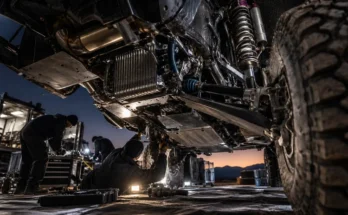
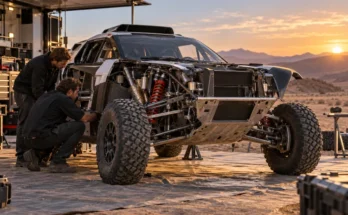
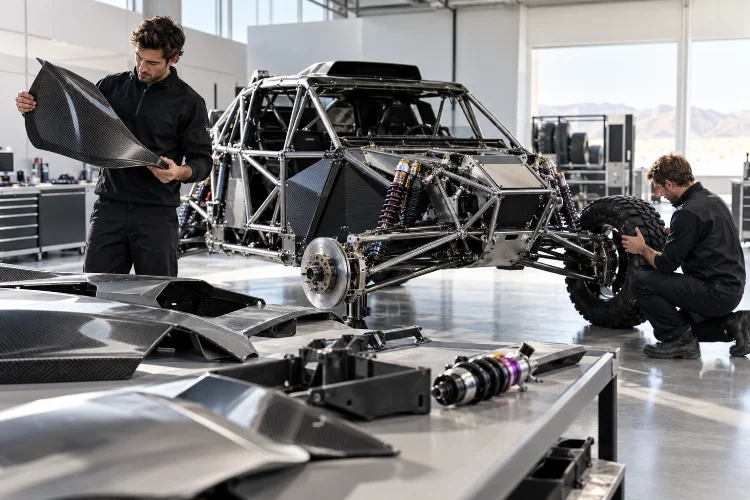
Most top-level Dakar prototypes use a tubular chassis rather than the standard body structure found in production SUVs.
This allows engineers to build strength directly into the areas carrying the highest loads.
Toyota uses a tubular frame for its Hilux Evo, while Ford’s Raptor T1+ uses a T45 steel spaceframe. Dacia’s Sandrider also has a tubular chassis with carbon-fibre bodywork.
The idea is structurally efficient.
Tubes can form a rigid three-dimensional structure around the crew while connecting suspension mounting points, drivetrain components, and other major systems.
Engineers can then use lightweight exterior panels because those panels do not need to carry the same structural loads.
Ford, for example, pairs its steel spaceframe with carbon-fibre body panels.
This separates two jobs.
The chassis provides strenght and occupant protection, while lightweight bodywork provides aerodynamics, cooling openings, and protection from the environment.
It is a much smarter solution than simply making every part thick and heavy.
4. Suspension Strength Has to Be Balanced Against Unsprung Mass
Suspension design creates one of the hardest weight-versus-strength problems.
Dakar suspension components experience enormous impacts. Control arms, uprights, hubs, dampers, wheels, and steering components must survive terrain that would quickly destroy ordinary road-car hardware.
But making these components excessively heavy creates another problem: unsprung mass.
Unsprung mass includes parts such as wheels and certain suspension components that move directly with the terrain.
More unsprung weight makes it harder for the suspension to keep the tyre following rough surfaces accurately.
Modern Ultimate cars therefore use sophisticated independent suspension with very large wheel travel.
Toyota, Dacia, and Ford all list around 350 mm of suspension travel on their current Dakar machines. Ford also uses adjustable external-bypass dampers with remote reservoirs designed for extreme durability.
Engineers want enough material to survive huge impacts without creating unnecessarily heavy moving parts.
Finding that balance requires extensive testing because theoretical strength alone does not show exactly how components will behave after thousands of repeated impacts.
5. Carbon Fibre Saves Weight Where Extreme Strength Is Less Critical
Carbon fibre appears on Dakar machines, but engineers do not simply build everything from it.
That would be expensive and, in many areas, impractical.
Instead, composite materials are most useful where large panels can be made lighter without compromising important structural functions.
Ford uses carbon-fibre body panels around its T45 steel frame. Dacia also specifies carbon-fibre bodywork around its tubular chassis, while Toyota uses a full composite Hilux-style body.
This is a good example of material optimisation.
Steel remains useful where toughness, predictable deformation, repairability, and concentrated load capacity matter.
Composite materials help remove unnecessary mass from exterior areas.
Using expensive lightweight material in the wrong place may save a few kilograms while making field repairs more complicated.
Dakar engineers therefore choose materials according to function rather than simply selecting whatever sounds most technologically advanced.
6. Stronger Components Can Actually Make the Car Faster
Adding weight sometimes improves performance.
That sounds contradictory, but Dakar is an endurance competition.
Imagine two suspension components. Part A weighs 6 kg and has an extremely low probability of breaking. Part B weighs 5 kg but is more vulnerable after repeated high-energy impacts.
The lighter component may offer a tiny handling benefit.
But if it fails once during the Dakar, the time lost repairing it could exceed every second gained through lower weight.
Toyota describes quality, durability, and reliability as central to the continued development of the GR DKR Hilux Evo. Its updates are based on accumulated racing experience rather than simply chasing headline specifications.
This is why engineers analyse component fatigue rather than only maximum load.
A control arm does not merely need to survive one massive landing. It may need to survive thousands of smaller impacts before encountering the large one.
That distinction encourages selective reinforcement.
The fastest Dakar car is often not the physically lightest car. It is the lightest car that can remain mechanically healthy.
7. Fuel Creates a Constantly Changing Weight Problem
A Dakar car does not maintain the same mass throughout a stage.
Fuel consumption changes the vehicle continuously.
Toyota lists a 540-litre tank in the GR DKR Hilux Evo. Even without converting that directly into a fixed fuel mass – which varies with fuel properties – it is obvious that hundreds of litres significantly affect vehicle weight.
Engineers therefore care deeply about where the fuel sits.
Placing it too high increases the centre of gravity. Putting too much mass toward one end of the car can change handling as the tank empties.
The ideal packaging tries to keep the fuel low and relatively central so changes in fuel level produce smaller changes in balance.
The same problem applies to spare wheels.
Large 37-inch Dakar tyres are heavy, yet crews need spares because punctures can decide stages.
Their location influences weight distribution, accessibility, and centre of gravity.
Good vehicle packaging is therefore not just about fitting everything inside.
It is about ensuring the car remains predictible as its operating weight changes.
8. Bigger Components Are Not Automatically Better
Engineers could theoretically make suspension arms, driveshafts, wheels, and skid plates extremely thick.
The car would probably become stronger.
It would also become slower, heavier, harder on tyres, and less efficient in soft terrain.
This is where computer simulation, testing, and real-world rally data become essential.
Teams identify where components actually experience maximum stress and reinforce those specific zones rather than adding material everywhere.
Toyota’s development philosophy relies heavily on continuous improvement from competition experience. The 2025 Hilux retained a proven core architecture while receiving refinements aimed at improving quality, durability, and reliability.
Ford took a similar functional approach with the Raptor T1+, combining its spaceframe and carbon panels with 400 mm of ground clearance, 37-inch tyres, and suspension designed specifically for high-load rally raid conditions.
Smart engineering therefore removes mass where loads are low and preserves it where failures would be expensive.
9. Weight Distribution Can Matter as Much as Total Weight
Two Dakar cars can weigh exactly the same and behave completely differently.
The reason is weight distribution.
A vehicle carrying too much mass over the front axle may dig into soft sand more aggressively and behave differently during dune transitions. Excess rearward weight can create its own handling problems.
Engineers consequently position major components strategically.
Engine location, fuel tank placement, spare wheels, cooling hardware, batteries, crew position, and drivetrain components all affect the centre of gravity.
Wheelbase also influences the compromise.
Dacia’s Sandrider uses a 3,000 mm wheelbase, while Toyota lists 3,140 mm for the Hilux Evo. Both combine those dimensions with long-travel double-wishbone suspension and large 37-inch tyres.
There is no single perfect number.
A longer platform can contribute to high-speed stability, while compact dimensions can make terrain transitions easier.
Engineers optimise the entire package rather than one measurement in isolation.
10. Real Dakar Speed Comes From the Whole Package
The final engineering target is not minimum weight, maximum rigidity, or maximum horsepower.
It is stage time.
A slightly heavier vehicle might be faster because the driver trusts its suspension enough to attack broken terrain. A reinforced chassis may allow more consistent handling after repeated impacts.
Likewise, a lightweight panel may free enough mass to strengthen a suspension mount without exceeding the regulated minimum.
This interconnected thinking defines Dakar development.
The FIA’s current regulations establish the technical framework for Ultimate-class prototypes, meaning teams search for performance within controlled limits rather than pursuing unrestricted designs.
Every decision affects something else.
Strength influences weight. Weight influences suspension loads. Suspension affects usable speed. Speed affects cooling, tyres, and drivetrain stress.
Dakar engineering is essentially the art of deciding which compromises cost the least performance.
Balancing speed, weight, and strength for the Dakar is far more complicated than simply building the lightest possible race car.
Engineers use tubular frames, composite body panels, carefully reinforced suspension, strategic component placement, and FIA minimum-weight rules to create vehicles that are both fast and capable of surviving extraordinary punishment.
Sometimes removing weight produces a clear advantage. In other areas, adding a stronger component makes the entire package faster because it reduces the risk of failure.
That is the real engineering challenge.
When you look at a modern Dakar prototype, do not judge it only by horsepower or weight figures. Look at how its materials, suspension, packaging, and structural design work together. In rally raid, every kilogram is part of a larger performance calculation.