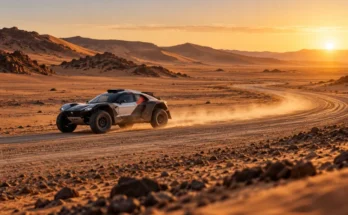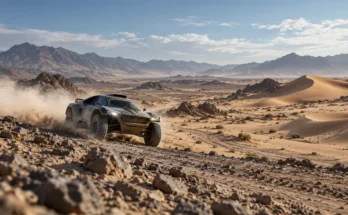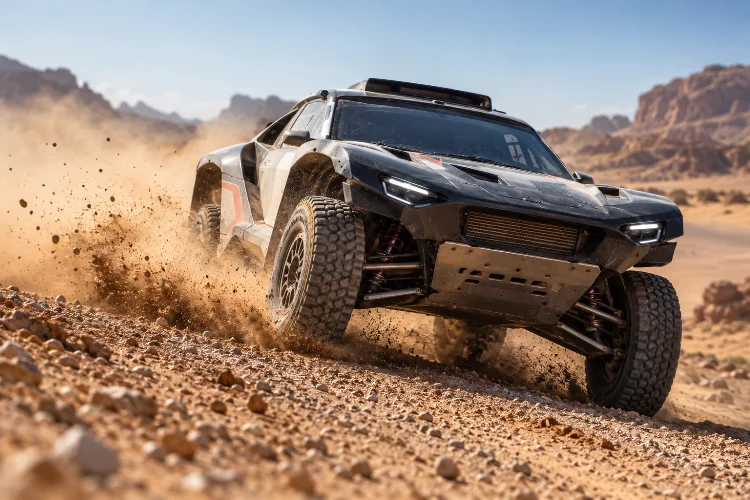
A Dakar Rally car rarely has the luxury of consistent grip.
One moment it may be travelling across firm gravel. Seconds later, the front tyres can hit loose sand, the rear wheels may slide over stones, or the whole vehicle may drop into a dune compression.
Through all of that, the driver has to keep more than two tonnes of race car balanced enough to accelerate, brake, and turn effectively.
That is where weight transfer becomes critical.
Whenever a driver brakes, accelerates, or changes direction, vehicle load moves between the tyres. On asphalt, those movements already influence grip.
On loose desert surfaces, where available traction can change dramatically from one metre to the next, poor weight control can quickly produce understeer, oversteer, wheelspin, or even a spin.
Understanding how Dakar drivers control weight transfer on loose desert surfaces therefore means looking at how elite competitors combine smooth inputs, momentum, suspension travel, tyre grip, and anticipation.
The fastest drivers are not simply reacting to slides. They are trying to prevent unnecessary instability before it begins.
1. Weight Transfer Starts Before the Corner
Drivers do not wait until the car is already turning to think about balance.
Braking immediately transfers load toward the front axle. The front tyres gain vertical load while the rear becomes relatively lighter.
That extra front loading can help the car begin turning, but too much braking can create problems.
On loose gravel or sand, a heavily unloaded rear axle may become unstable. If the driver turns sharply while still braking aggressively, the rear of the car can rotate faster than intended.
Elite drivers therefore manage braking progressively.
Rather than hitting the pedal as hard as possible and then releasing it suddenly, they often build braking pressure smoothly and reduce it as the car approaches the turn.
This keeps the chassis more predictable.
The objective is to arrive at the corner with enough load on the front tyres to help steering without creating so much rear instability that the car becomes difficult to control.
2. Trail Braking Helps Rotate the Car – When Used Carefully
A small amount of braking can sometimes remain as the driver begins turning.
This technique, broadly known as trail braking, keeps some weight toward the front axle and can help the car rotate into a corner.
On loose desert surfaces, however, the margin is smaller than it might be on clean asphalt.
The tyre has limited grip available. If too much of that grip is being used for braking, less remains available for steering.
Dakar drivers therefore use the technique carefully.
A light braking load may help point the nose toward the exit, but excessive pedal pressure can cause the front tyres to slide or make the rear suddenly step out.
The amount depends on surface condition.
Firm gravel may tolerate a more aggressive transition, while deep sand usually rewards smoother, earlier preparation.
The driver is constantly judging how much longitudinal and lateral force the tyres can handle at the same time.
3. Throttle Moves Weight Rearward and Restores Stability
Once the driver begins accelerating, load transfers toward the rear.
That can be extremely useful.
After rotating the car into a turn, progressive throttle helps settle the rear axle and moves the vehicle toward the exit.
But there is a limit.
If the driver applies too much power while the tyres are still heavily loaded sideways, the rear wheels can break traction. On sand, excessive wheelspin may also dig the tyres into the surface and destroy momentum.
The fastest drivers therefore feed power in rather than treating the throttle like an on-off switch.
This becomes especially important in dunes.
Carrying enough throttle maintains momentum and keeps the vehicle moving over soft ground, but abrupt power application can upset the chassis just when the driver needs it balanced.
Sébastien Loeb highlighted how aggressively modern Dakar cars can be driven through dunes during the 2026 rally, while also noting how physically violent the terrain becomes when attacking hard.
The challenge is using enough throttle to stay fast without creating unnecessary wheelspinn.
4. Smooth Steering Prevents Sudden Side-to-Side Load Shifts
Steering creates lateral weight transfer.
Turn left and the vehicle loads its right-side tyres. Turn right and the opposite happens.
Sudden steering inputs make those transfers happen more aggressively.
On loose surfaces, this can exceed the grip available almost immediately.
That is why experienced Dakar drivers often use surprisingly smooth steering even when travelling quickly.
They try to introduce steering angle progressively, allow the chassis to settle, and avoid making large corrections halfway through a corner.
A correction is sometimes necessary, of course. Loose terrain is unpredictable.
But every additional steering movement creates another load transition.
Keeping the car balanced requires fewer, more deliberate inputs.
This becomes even more important with modern Dakar vehicles running large tyres and long-travel suspension.
The Toyota GR DKR Hilux T1+, for example, uses double-wishbone suspension with 350 mm of travel and 37-inch tyres, giving the chassis enormous ability to absorb terrain while still demanding careful control from the driver.
5. Long-Travel Suspension Slows and Controls Weight Movement
Dakar suspension is designed to accommodate enormous vertical movement.
Ford’s Raptor T1+, for example, uses independent double-wishbone suspension with external-bypass dampers and up to 350 mm of wheel travel.
That suspension does more than absorb jumps.
It also controls how quickly vehicle mass moves during braking, acceleration, cornering, and terrain impacts.
Dampers resist sudden suspension movement, helping prevent the chassis from pitching or rolling uncontrollably.
If the front suspension compresses too quickly under braking, the vehicle may become nervous and overload its front tyres. If rear movement is poorly controlled under acceleration, traction can become inconsistent.
Teams therefore tune damping to achieve a compromise.
The suspension needs enough compliance to follow rough ground while still keeping the body controlled during major weight shifts.
Drivers then learn how quickly their particular car responds.
A strong driver does not fight the suspension. They time their inputs around how the chassis naturally moves.
6. Loose Sand Rewards Momentum More Than Aggressive Weight Transfer
Deep sand changes many normal driving rules.
Hard braking is usually expensive because it immediately kills momentum.
Once the car slows too much, the tyres have to push through soft material again, increasing wheelspin and drivetrain load.
Drivers therefore try to keep weight transfer relatively gentle.
Instead of braking deeply into a dune transition, they may lift earlier and allow engine braking and rolling resistance to reduce speed progressively.
Throttle is then reapplied smoothly before the vehicle loses too much momentum.
Line choice becomes crucial.
Henk Lategan explained after a full dune stage in Dakar 2026 that only a couple of mistakes in line selection were enough to cost significant time compared with the leading pace.
A good line lets the vehicle move naturally.
A poor one can force sudden braking, steering corrections, or full-throttle recovery – all of which create larger and less predictable weight transfers.
7. Rocky Terrain Requires a Different Balance Strategy
Rocks reward caution in a different way.
The driver still needs enough speed to remain competitive, but sudden load spikes can damage tyres, wheels, or suspension.
Lucas Moraes described deliberately reducing his speed through rocky and narrow sections during Dakar 2026 because protecting the car for the following stage mattered more than attacking every kilometre.
That approach also reduces violent weight movement.
Hitting a rock while heavily braking loads the front axle even more. Striking one while cornering hard can combine vertical impact with lateral tyre load.
Experienced drivers therefore try to straighten the car before the largest obstacles.
A brief lift or small reduction in steering angle can reduce the number of forces acting on the tyre simultaneously.
This is a classic rally-raid principle: sometimes giving away a tiny amount of speed before an obstacle lets the car carry much more speed afterward.
8. Drivers Use Small Slides Instead of Fighting Every Movement
A perfectly neutral car is not always possible on loose terrain.
Nor is it necessarily desirable.
Dakar drivers often allow controlled rotation because a small slide can help point the vehicle toward the exit without requiring excessive steering angle.
The key word is controlled.
If the rear rotates slightly as load moves forward, the driver can manage the movement with throttle and steering. If rotation becomes too large, momentum disappears and tyre temperatures rise.
Expert drivers therefore distinguish between useful movement and wasted movement.
They do not immediately fight every small slide.
Instead, they evaluate whether the chassis is naturally moving toward the desired direction.
This requires excellent feel.
A car that is rotating smoothly may need only a small throttle adjustment. A vehicle beginning to snap sideways requires a much faster response.
That difference between allowing motion and correcting instability is one of the hardest off-road skills to learn.
9. Driver Inputs Have to Match Changing Grip
One Dakar stage can contain several completely different grip levels.
Firm sand can suddenly become soft. Gravel may transition into exposed rock. Rain can change how tightly the surface packs together.
The driver therefore cannot use one fixed braking point or one steering technique.
Mattias Ekström noted during Dakar 2026 that stage characteristics could differ sharply from expectations, including differences in dune pace, fast terrain, and dust.
Weight transfer strategy changes with those conditions.
On higher-grip surfaces, a driver can use more aggressive braking and steering because the tyres can support greater combined force.
On loose ground, the same input may overwhelm traction.
The best competitors make these adjustments almost subconsciously.
They are continuously testing the available grip through small braking, steering, and throttle inputs.
Then they adjust the next movement accordingly.
This is why Dakar driving is so difficult to reduce to a simple technique.
The correct answer changes every few seconds.
10. Tyre Design Influences How Weight Transfer Feels
Tyres form the final connection between all that moving mass and the desert.
BFGoodrich’s Dakar rally-raid tyres are specifically designed around loose surfaces, with open tread features intended to clear sand and maintain traction in dunes.
Large tyre sidewalls also deform under load.
As weight transfers toward one corner of the vehicle, the tyre compresses and changes shape. Pressure influences how much that happens.
Lower pressure can improve flotation and compliance in sand but may make the tyre feel less precise during sudden steering inputs.
Higher pressure can sharpen responses but may reduce flotation and increase harshness over some terrain.
Teams therefore tune tyre pressure alongside suspension setup.
The driver’s technique must then adapt to the resulting behaviour.
Weight transfer is not happening only through springs and dampers.
The tyres themselves are part of the system.
11. The Fastest Drivers Minimize Unnecessary Transfers
Every major shift of vehicle mass takes time.
Hard braking pitches the car forward. Aggressive acceleration moves it back. Sharp steering moves it sideways.
Doing all three repeatedly creates a vehicle that never settles.
Smooth drivers reduce those unnecessary transitions.
Michael Docherty provided a useful example from the motorcycle side of Dakar 2026 when he described choosing a “nice, smooth pace” through the dunes after an earlier mistake and still produced a strong stage performance.
The same philosophy applies to cars.
The goal is not to eliminate weight transfer – it is physically unavoidable.
The goal is to make it predictable.
Drivers brake once rather than repeatedly adjusting. They choose a clean steering arc rather than making several corrections. They progressively increase throttle instead of repeatedly breaking traction.
That consistancy lets the tyres, suspension, and driver work together rather than constantly recovering from instability.
Dakar drivers control weight transfer by managing how quickly vehicle load moves between the tyres.
Smooth braking loads the front axle without destabilising the rear. Progressive throttle restores rear grip, while controlled steering prevents sudden lateral shifts.
Long-travel suspension and large off-road tyres help absorb those movements, but the driver still has to adapt technique to rocks, gravel, dunes, and constantly changing grip.
The key is rarely to eliminate movement. It is to keep that movement predictable.
Watch a top Dakar driver closely and the car may look surprisingly calm even at enormous speed. That is usually intentional.
By reducing unnecessary pitch, roll, wheelspin, and corrections, elite competitors preserve momentum and give each tyre the best possible chance to find grip.
In loose desert racing, balance is speed.