A Dakar Rally car does not need to survive one spectacular jump. It needs to survive thousands of them – along with rocks, deep sand, dust, extreme heat, high-speed tracks, and hours of continuous mechanical stress.
That changes almost every engineering decision.
The 2026 Dakar covered around 8,000 kilometres, including roughly 5,000 kilometres of timed competition, and featured marathon-refuge stages where normal team assistance was heavily restricted.
A car that feels perfect for a short test therefore means very little if suspension components, cooling systems, or drivetrain parts begin failing halfway through the rally.
Understanding how Dakar teams design vehicles for thousands of harsh kilometers is really about understanding endurance engineering.
Teams need speed, but they also need predictable component life, effective cooling, strong chassis structures, repairable systems, and enough mechanical margin to survive conditions that are rarely repeated exactly.
A successful Dakar car is designed to keep moving.
1. Durability Starts With the Chassis
The chassis forms the foundation of a Dakar prototype.
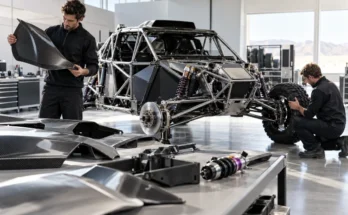
Modern Ultimate-class vehicles generally use purpose-built tubular structures rather than depending on a conventional production-car body.
Ford’s Raptor T1+, for example, uses a T45 steel spaceframe combined with carbon-fibre body panels. Toyota’s GR DKR Hilux Evo also uses a tubular frame beneath its composite exterior.
This construction allows engineers to put structural strength exactly where it is needed.
Suspension mounting areas can be reinforced heavily, while exterior panels can remain relatively light because they do not need to carry major chassis loads.
The difficult part is designing for fatigue.
A frame may easily survive one hard landing but still develop cracks after thousands of smaller impacts. Engineers therefore calculate repeated load cycles and then validate those predictions with extensive desert testing.
In Dakar, strenght is not about surviving the biggest impact once. It is about surviving continuous punishment without gradually losing structural integrity.
2. Suspension Has to Work for Hundreds of Kilometres at a Time
Long-travel suspension is one of the most recognisable features of Dakar cars.
Toyota’s GR DKR Hilux Evo uses double-wishbone suspension with 350 mm of travel at the front and rear. Ford also lists up to 350 mm of wheel travel for the Raptor T1+, using adjustable dampers with external reservoirs.
That movement helps the wheels follow extremely uneven terrain while reducing the amount of impact transferred into the chassis.
However, suspension performance changes as components heat up.
Dampers repeatedly convert movement into thermal energy. During a long rough stage, engineers need them to behave consistently after several hours, not simply during the first few kilometres.
This means reservoir capacity, damper oil, seals, spring rates, compression control, and rebound settings all matter.
Teams must also prevent suspension components from becoming unnecessarily heavy. Stronger arms may improve reliability, but additional unsprung mass can make it harder for the wheels to react quickly to rough terrain.
The best setup balances travel, control, weight, and durabilty.
3. Cooling Systems Are Designed Around the Worst Conditions
High ambient temperature is only one part of Dakar cooling.
Deep sand creates an even harder engineering problem because the engine may be operating under heavy load while the vehicle moves relatively slowly.
That means high heat generation with less airflow through the radiators.
Sand can also restrict cooling openings.
Dacia’s upgrades for Dakar 2026 showed how detailed this challenge becomes.
The Sandrider received a redesigned rear radiator grille intended to maintain cooling even when partially obstructed, a foam filter to reduce sand entering the front fan, faster fan motors, revised electronics, and a water-cooled DC-DC unit.
These are not glamorous modifications, but they can decide whether a vehicle finishes.
Teams also need to manage transmission, differential, electronics, and damper temperatures.
Cooling is therefore designed with margin. Engineers assume that airflow will sometimes be poor, filters will become dirty, and the vehicle will spend long periods working extremely hard.
The system has to perform anyway.
4. Drivetrains Must Survive Thousands of Shock Loads
Dakar drivetrains experience brutal changes in load.
Imagine a wheel spinning freely after leaving the ground. When the vehicle lands, the tyre suddenly regains grip and sends a sharp torque spike through the hub, driveshaft, differential, gearbox, and clutch.
Now repeat that process hundreds or thousands of times.
Toyota uses a six-speed sequential gearbox with limited-slip differentials at the front, centre, and rear of its Hilux Evo. Dacia’s Sandrider also uses four-wheel drive and a six-speed sequential transmission.
The challenge is making these parts strong enough without making them excessively heavy.
Dacia’s ongoing development provides a good example. Ahead of the 2026 Dakar, the team updated several areas of the Sandrider with reliability and component life in mind after learning from its earlier competition programme.
Engineers do not only ask how much torque a driveshaft can survive.
They ask how many repeated torque cycles it can handle before fatigue becomes dangerous.
5. Large Fuel Capacity Creates a Packaging Puzzle
A long Dakar stage requires significant fuel capacity.
Toyota’s GR DKR Hilux Evo, for example, uses a 540-litre FT3 safety fuel cell while maintaining a listed FIA minimum dry weight of 2,010 kg.
Fitting that much fuel into a competitive race car is complicated.
The tank needs protection from crashes and impacts while remaining positioned so that its weight does not destabilise the vehicle.
Engineers generally want heavy components low and relatively close to the centre of the car.
They also have to remember that fuel mass is continuously changing.
A vehicle leaving the start with a large fuel load may behave differently several hours later when much of that fuel has been consumed.
At the same time, teams need room for spare wheels, tools, cooling hardware, safety equipment, electronics, and crew supplies.
Good Dakar packging is therefore about much more than finding enough physical space. It is about maintaining predictable handling as the car’s operating mass changes.
6. Tyres Are Treated Like Structural Components
Dakar tyres are part of the suspension system as much as they are part of the drivetrain.
Toyota, Ford, and Dacia all use the modern T1+ combination of 37-inch off-road tyres with 17-inch wheels on their leading prototypes.
Large sidewalls help absorb impacts and allow pressure changes to influence how the car behaves over different terrain.
Lower pressures can improve flotation in soft sand. Higher pressures may provide better support in rocky environments.
But tyre design affects many other components.
Large tyres place substantial loads on bearings, hubs, steering parts, suspension arms, and brakes. Their weight also contributes to unsprung mass.
Engineers therefore design the surrounding hardware around the tyre package instead of treating wheels as an isolated system.
And because punctures remain a constant Dakar risk, the vehicle must also carry spare wheels without destroying weight distribution.
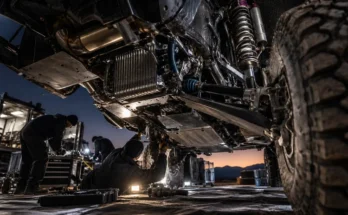
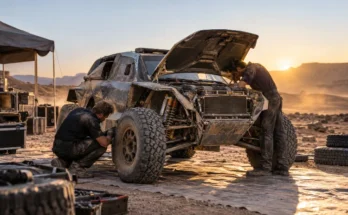
7. Components Must Be Easy to Repair in the Desert
A Dakar vehicle cannot depend entirely on a workshop.
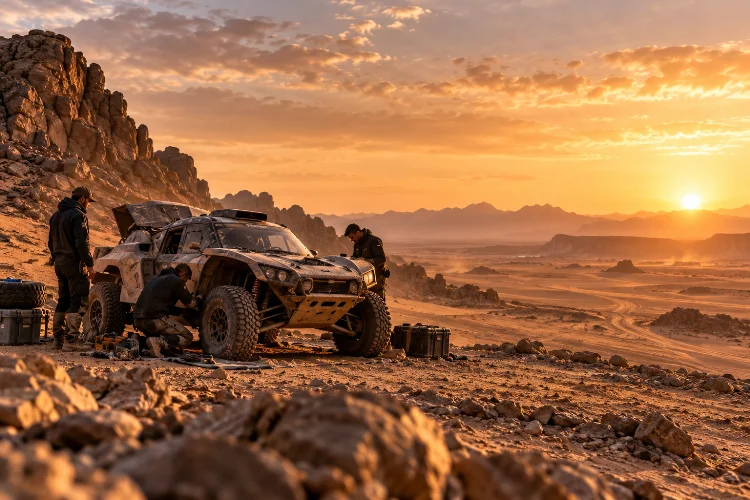
Sometimes the crew has to repair the car far from normal assistance, while marathon stages can further restrict what the professional service team is allowed to do. The 2026 event included two marathon-refuge stages where only competitor-to-competitor assistance was permitted.
That makes serviceability part of vehicle design.
Engineers think about bolt access, component location, connectors, spare-part dimensions, and how many other pieces must be removed before reaching the failed component.
A part that takes 15 minutes to replace may be more valuable than one that is marginally lighter but takes an hour.
Teams also identify likely failure items and decide which spares should travel inside the vehicle.
That means engineering involves probability.
Which parts are likely to fail? Which failures can the crew realistically fix? Which components are too heavy to carry as spares and therefore need an extremely high reliability margin?
These questions influence the design long before the car enters Saudi Arabia.
8. Testing Is About Finding the End of Component Life
Dakar teams deliberately try to expose weaknesses before the rally does.
Toyota reported nearly 30,000 kilometres of racing and testing during development of the GR DKR Hilux Evo, including work focused on cooling, suspension, quality, durability, and reliability.
Dacia followed a similar philosophy with the Sandrider.
Technical director Philip Dunabin explained before the team’s first Dakar that development included engine-reliability testing, cooling optimisation, and studying the expected life of individual parts so the team could plan enough components to reach the rally finish.
That last point is important.
Engineers do not merely classify components as “working” or “broken.”
They want to understand degradation.
A bearing might theoretically survive 6,000 kilometres, but its condition could deteriorate rapidly after 4,500. A team can then replace it preventively before it becomes a stage-ending failure.
This turns testing data into race strategy.
9. Weight Reduction Must Never Create Fragility
Reducing mass remains valuable because lighter vehicles accelerate more easily, place less stress on suspension and tyres, and generally perform better in soft sand.
But Dakar engineers cannot remove weight blindly.
Dacia’s 2026 Sandrider development included lighter body panels specifically to improve agility and efficiency, while reliability improvements were made elsewhere in the same vehicle.
That combination illustrates the correct approach.
Save weight in body panels where the structural penalty is small. Keep or add material where drivetrain, suspension, cooling, or safety reliability depends on it.
FIA regulations also shape these choices. The 2026 technical framework defines Ultimate prototypes and sets the boundaries inside which teams can develop their cars.
The objective is not to create the lightest machine imaginable.
It is to use every kilogram effectively.
Designing a Dakar vehicle for thousands of harsh kilometres requires a very different mindset from building a machine for short bursts of speed.
Teams strengthen tubular chassis structures against fatigue, develop long-travel suspension for repeated impacts, protect drivetrains from shock loads, and engineer cooling systems that continue working even when sand restricts airflow.
At the same time, they must manage fuel, spare tyres, weight distribution, and field repairs. Most importantly, every component has to be considered over its full working life.
That is why Dakar engineering is so fascinating. A car cannot simply be fast when it leaves the start. It needs to remain fast after days of heat, vibration, rocks, and dunes.
When watching the next Dakar, look beyond horsepower. The real engineering victory is seeing the same machine still attacking hard thousands of kilometres later.