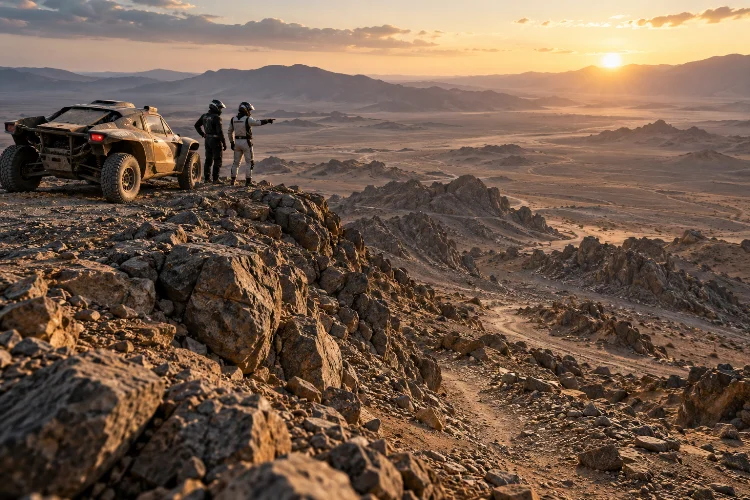
The fastest decision in the Dakar Rally is not always the smartest one.
A driver can attack a rocky section, gain 30 seconds, and look brilliant at the next checkpoint. Ten kilometres later, one puncture or damaged suspension component can erase that advantage several times over.
That constant tension makes rally raid very different from motorsport where competitors repeatedly race around the same predictable circuit.
Dakar 2026 illustrated the scale of the challenge with an approximately 8,000-kilometre route, including around 4,900 kilometres of timed competition. The course mixed dunes, mountains, rocky plateaus, fast tracks, and marathon sections with restricted assistance.
That is why strategic decision making during high-risk Dakar Rally stages matters so much. Crews must continuously decide whether to attack, protect tyres, trust another competitor’s tracks, slow for navigation, or preserve the vehicle for another day.
In Dakar, good judgement can be every bit as valuable as outright speed.
1. Risk Is Constantly Changing During a Dakar Stage
Dakar crews do not start a special with one risk level and maintain it until the finish.
Conditions can change every few kilometres.
An open desert track may allow a driver to attack aggressively with relatively low risk. Minutes later, the route can enter an area filled with sharp rocks, hidden ditches, confusing intersections, or dust from another competitor.
Elite drivers adjust immediately.
Nasser Al-Attiyah demonstrated this during Stage 1 of Dakar 2026. After learning that teammate Sébastien Loeb had already suffered two punctures, Al-Attiyah deliberately reduced his risk rather than continuing at maximum attack.
He still finished just 40 seconds behind stage winner Guillaume de Mévius.
This kind of decison shows how Dakar strategy works in practice. The objective is not simply to drive as quickly as possible, but to decide where additional speed is actually worth buying with additional risk.
2. Tyre Preservation Can Override the Desire to Attack
Tyres are one of the first things drivers consider when terrain becomes rough.
A puncture costs more than the time required to change the wheel. It also removes one spare from the vehicle, potentially forcing the crew to become much more cautious for the remainder of the stage.
That creates a constantly changing risk budget.
A driver with every spare available may attack a rocky section differently from someone who has already suffered two punctures. What seemed like an acceptable line 100 kilometres earlier may suddenly become unnecessarily dangerous.
This is why experienced Dakar competitors often sacrifice small amounts of time in rocky areas.
The calculation is straightforward: losing 15 seconds because you avoided a sharp line is usually preferable to losing several minutes while changing a tyre.
Tyre management therefore becomes part of race strategy rather than simply mechanical maintenance.
3. Navigation Decisions Can Save or Destroy Minutes
Navigation adds another layer to Dakar risk management.
FIA rally-raid regulations require crews to validate different types of waypoints by entering specified validation areas.
Missing certain navigation waypoints can produce substantial time penalties; under the 2026 regulations, for example, missing a WPN carries a significantly heavier penalty than standard navigation waypoints.
That means maximum speed is useless if the vehicle is travelling in the wrong direction.
When the roadbook becomes complicated, experienced drivers often give navigators more time to interpret instructions. Reducing speed for a few seconds can prevent overshooting a junction and spending several minutes searching for the correct route.
Henk Lategan experienced just how difficult this becomes while opening a Dakar 2026 stage. With no motorcycle tracks available and some small tracks affected by rain, he described it as one of the most difficult stages he had ever opened.
Good navigaton therefore changes the amount of aggression a driver can safely use.
Certainty allows speed. Uncertainty demands margin.
4. Marathon Stages Reward Long-Term Thinking
Marathon stages dramatically increase the consequences of mechanical damage.
The 2026 Dakar featured two marathon-refuge stages where competitors faced heavily restricted assistance between days.
Crews therefore had to consider not only how quickly they could complete the current stage, but also what condition their vehicle would be in for the next one.
That changes the value of aggression.
During Stage 5 of Dakar 2026, Al-Attiyah chose not to force his way past Lategan because the conditions were risky and navigation was difficult. He indicated that losing around ten minutes was acceptable if the crew could complete the marathon section cleanly.
In a normal sprint race, voluntarily giving away that much time could look disastrous.
In Dakar, it can be completely rational.
A damaged suspension component, broken steering system, or drivetrain problem without full service support could cost considerably more.
5. Dust Forces Drivers to Choose Between Visibility and Time
One of the hardest strategic decisions happens when a fast competitor catches another vehicle.
Dust can make overtaking extremely dangerous.
The following driver may know that staying behind costs valuable seconds, but attacking without clear visibility means entering corners, rocks, drops, and other obstacles with incomplete information.
Dania Akeel described this problem during Dakar 2026, saying that on heavily dusty stages performance can become as much about someone’s appetite for risk as pure driving ability. She explained that closing the gap may require taking risks that simply are not worthwhile.
The sensible approach depends on the situation.
A competitor fighting for a rally victory on the final stages may accept greater danger. Someone protecting a comfortable classification position may choose to wait for a safer passing opportunity.
This makes visiblity another strategic resource.
Sometimes seeing where you are going is worth more than immediately gaining ten seconds.
6. Drivers Must React When the Vehicle Starts Failing
Risk management becomes even more complicated when the vehicle develops a problem.
The original stage strategy may become irrelevant within seconds.
Sébastien Loeb experienced this during Stage 9 of Dakar 2026 when his Dacia lost power steering. He had started the special at competitive pace, but the failure forced him to cover approximately 180 kilometres without normal steering assistance, making the dunes particularly difficult.
At that point, the strategic objective changes.
Instead of asking, “How much time can we gain?” the crew may ask, “How do we reach the finish without making this problem worse?”
Drivers monitor temperatures, vibrations, steering response, tyre condition, and unusual noises throughout the stage.
A minor issue may allow continued racing at reduced pace. A serious mechnical problem might require stopping before additional damage turns a repairable failure into retirement.
The best competitors are not only fast enough to notice performance changes. They are experienced enough to respond correctly.
7. Overall Classification Determines How Much Risk Makes Sense
Risk has different value depending on where a competitor sits in the standings.
A driver trailing the leader by 30 minutes near the end of the rally may need to gamble. Finishing safely but gaining nothing could effectively guarantee defeat.
The leader faces a different equation.
If a competitor holds a comfortable advantage, winning another stage may offer little benefit compared with the potential cost of a puncture, crash, or navigation mistake.
That means Dakar strategy cannot be separated from the general classification.
Teams continuously consider the gaps ahead and behind them, remaining stages, upcoming terrain, starting position, and the performance of their closest rivals.
Even stage victory can create strategic complications.
Opening the road the following day may mean navigating without useful tracks from earlier competitors. Crews therefore consider tomorrow’s starting position when deciding how aggressively to finish today.
Dakar is essentially a sequence of connected strategic problems rather than isolated races.
8. Clean Stages Often Beat Spectacular Stages
Perhaps the most underrated Dakar strategy is simply avoiding mistakes.
Mitch Guthrie’s first Ultimate-class Dakar stage victory in 2026 came after what he described as a clean day: strong navigation, no flat tyres, and a reliable car that allowed the crew to keep moving consistently.
That sounds less dramatic than an enormous jump over a dune or a desperate high-speed overtake.
But uninterrupted movement is extremely powerful in rally raid.
Sébastien Loeb offered another useful perspective after a 480-kilometre stage in Dakar 2026. He explained that a navigation mistake near the finish had cost roughly two to three minutes—time his crew had spent the entire stage trying to gain.
When leading competitors are operating at similar speeds, avoiding mistakes becomes one of the few reliable ways to create an advantage.
The winning strategy is often not spectacular.
It is simply clean.
Strategic decision making is what turns Dakar speed into Dakar performance.
Elite crews constantly balance pace against puncture risk, navigation uncertainty, dust, mechanical condition, starting position, and the overall classification.
They know that attacking can create crucial advantages, but they also understand that unnecessary aggression can erase days of progress within minutes.
The strongest Dakar competitors therefore do something harder than simply driving fast: they repeatedly make good decisions while tired, under pressure, and travelling through unpredictable terrain.
When you watch the next Dakar stage, look beyond the fastest split times. Notice who protects tyres, slows before confusing navigation, manages damaged machinery, and chooses the right moment to attack. Those decisions often explain the final standings better than raw speed alone.