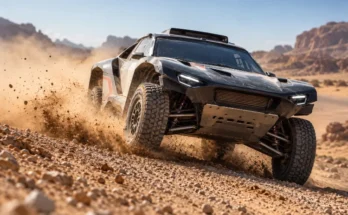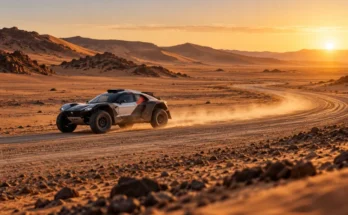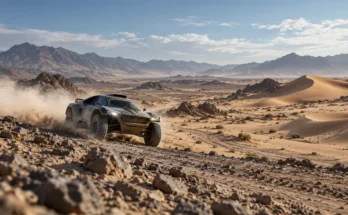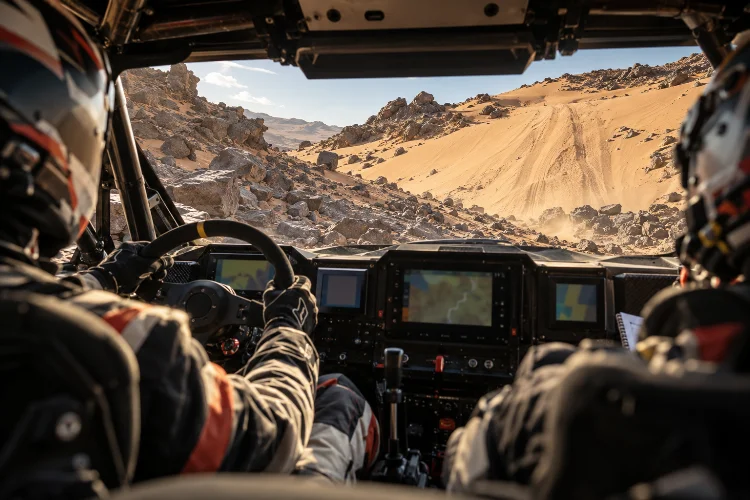
Pressing the accelerator sounds like the simplest part of driving a Dakar Rally car. In reality, throttle control becomes one of the driver’s most important tools when the surface changes every few kilometres.
Deep sand demands momentum. Too little throttle and the vehicle can sink or struggle up a dune. Too much and the tyres may spin uselessly, digging into the surface while adding heat and drivetrain stress.
Rocky terrain creates almost the opposite problem. Sudden acceleration can produce wheelspin, expose tyres to sharp impacts, and send harsh torque loads through the driveline.
Drivers need enough power to maintain pace without turning every exposed rock into a potential puncture.
That is why managing throttle input across deep sand and rocky Dakar terrain is much more complicated than simply deciding how far to press the pedal.
Elite drivers constantly adjust power according to grip, tyre condition, slope, line choice, suspension movement, and what the terrain is likely to do next.
Good throttle technique is ultimately about converting engine power into useful forward motion while wasting as little energy – and equipment – as possible.
1. Deep Sand Rewards Momentum, Not Maximum Wheelspin
The first rule of deep sand is to keep moving.
Once a heavy Dakar car loses too much momentum, its tyres begin pushing through rather than floating over the loose surface. Recovering speed then requires more engine power, which can generate even more wheelspin.
Experienced drivers therefore try to carry enough speed into soft sections before they actually need it.
The throttle is applied progressively so the tyres continue driving the vehicle forward rather than immediately breaking traction.
Tyre design helps. BFGoodrich explains that its Dakar rally-raid tread uses an open pattern, particularly around the shoulders, to clear sand and generate traction on softer terrain.
But even the best tyre cannot compensate for poor throttle technique.
Aggressive wheelspinn may look spectacular, yet if the vehicle is throwing sand backward instead of accelerating forward, energy is being wasted.
2. Dune Climbs Require Power Before the Slope Gets Steep
A driver should not wait until halfway up a dune to discover that more speed was needed.
Instead, experienced competitors read the slope early.
They build momentum before the climb, choose an appropriate gear, and use enough throttle to maintain speed as gravity and soft sand begin slowing the vehicle.
The challenge is avoiding panic.
If speed begins dropping, simply stamping harder on the throttle may increase wheelspin without producing meaningful acceleration. Once the tyres start digging downward, the situation can deteriorate quickly.
The best drivers therefore try to make the dune one continuous movement.
Henk Lategan showed how important these details are during Dakar 2026. On a full dune stage, he said only a couple of mistakes in line choice were enough to cost time against the leading pace.
Throttle and line choice work together. A clean line requires less corrective acceleration, while a poor line may force the driver to use much more power simply to recover lost momentum.
3. Drivers Ease the Throttle Near Dune Crests
What happens near the top of a dune is just as important as the climb.
A driver approaching the crest at full throttle can launch the vehicle farther than intended. The landing may then create huge suspension loads or place the car in a poor position for the next descent.
Elite drivers often reduce throttle as the crest approaches.
The objective is to arrive with enough momentum to cross the top without carrying unnecessary speed into an area where the terrain on the other side may be difficult to see.
Sébastien Loeb described how fast modern Dakar cars can travel through dunes during Dakar 2026, but he also noted how physically violent attacking hard in them can become.
That makes throttle release part of mechanical preservation.
The driver is not necessarily slowing because the engine lacks performance. They are controlling how much energy the suspension and tyres will have to absorb after the crest.
4. Rocky Terrain Demands More Delicate Power Delivery
When sand turns into rocks, the throttle strategy changes immediately.
Traction may actually improve on firmer ground, but the consequences of a sudden impact become much greater.
Imagine one tyre becoming briefly airborne over a rock while the driver remains heavily on the throttle. The wheel can accelerate while unloaded, then suddenly regain grip when it lands.
That creates a sharp torque change through the tyre, hub, driveshaft, differential, and transmission.
Modern Dakar vehicles are designed to tolerate enormous punishment. Ford’s Raptor T1+, for example, combines four large 37-inch tyres with up to 350 mm of suspension travel and heavy-duty rally-raid dampers.
Still, avoiding unnecessary shock loading improves reliability.
Drivers therefore use smaller throttle movements over badly broken ground, particularly while the suspension is rapidly extending and compressing.
Smooth power protects both traction and drivtrain components.
5. A Brief Lift Can Be Faster Than Staying Flat
Lifting off the accelerator feels like giving away time.
Sometimes it saves much more.
If the driver spots an especially sharp rock, deep hole, or violent compression, a short throttle lift can reduce the vehicle’s speed and settle the chassis before impact.
That small reduction may prevent a puncture.
Nasser Al-Attiyah demonstrated this wider philosophy during Stage 1 of Dakar 2026.
After seeing teammate Sébastien Loeb suffer two flat tyres, he deliberately became more cautious rather than continuing at maximum attack. Al-Attiyah still finished only 40 seconds behind the stage winner.
Henk Lategan’s prologue offered the opposite reminder. His car struck a rock while running through a sandy rut and suffered a puncture that cost significant time.
Over a long stage, a tiny lift is cheap.
Stopping to change a wheel is not.
6. Throttle Helps Control Vehicle Balance
The accelerator does more than determine engine output.
It also changes vehicle balance.
When a driver accelerates, weight transfers toward the rear axle. A controlled amount of throttle can therefore settle the back of the vehicle as it exits a loose corner.
Too much throttle produces the opposite result.
If the rear tyres exceed their available grip, the vehicle can rotate more aggressively than intended. The driver then needs counter-steering or a throttle correction, which wastes momentum.
Progressive throttle allows the car to transition smoothly from cornering to acceleration.
This becomes particularly important when one corner contains several surfaces. The car might enter on firm gravel, cross loose sand at the apex, and exit onto rocks.
The available traction changes before the steering wheel is even straight.
Drivers therefore do not use one fixed throttle position. They continuously adjust pedal pressure according to what each tyre is likely to encounter.
7. Choosing the Right Gear Makes Throttle Easier to Control
Throttle management is closely connected to gear selection.
A lower gear can provide strong acceleration, but it also delivers more torque to the wheels. In very loose sand, that can make wheelspin easier to trigger.
Using a taller gear can sometimes create smoother torque delivery and help the tyres maintain traction.
However, selecting too high a gear brings another danger: the engine may fall out of its useful operating range and the vehicle can lose momentum.
This is why dune driving requires anticipation.
Drivers want the engine ready to respond before the difficult section begins rather than making desperate gear changes halfway through a climb.
On relatively easy, fast terrain, competitors can use much more sustained throttle. Daniel Sanders described one Dakar 2026 stage as relatively straightforward and effectively more about opening the throttle than dealing with extremely complex conditions.
The important point is that this technique cannot simply be carried into every terrain type.
The Dakar changes too quickly for one throttle strategy to work everywhere.
8. Tyre Condition Changes How Aggressively Power Can Be Used
Throttle decisions also depend on what has already happened earlier in the stage.
A crew starting with healthy tyres and all of its spares available has more strategic freedom than one that has already suffered two punctures.
Once spare capacity disappears, aggressive acceleration across sharp rocks becomes much harder to justify.
Dakar tyres are designed around a difficult compromise. BFGoodrich describes competition tyres as needing resistance to shocks and punctures while still producing enough grip for speed and remaining suitable for changing terrain.
Throttle affects all of those demands.
Wheelspin increases tyre movement and heat. Hard acceleration can expose a tyre to larger forces when it strikes rocks. Smooth torque delivery helps maintain traction with less unnecessary stress.
This is why tyre preservation begins at the driver’s right foot, not only with pressure settings or tyre construction.
9. Smooth Throttle Can Reduce Driver Workload
Aggressive throttle inputs create reactions that then require correction.
Heavy wheelspin may cause the rear to step sideways. The driver counter-steers, reduces power, waits for grip to return, and then accelerates again.
Every correction adds workload.
Smooth inputs make the vehicle more predictable.
That becomes increasingly valuable after several hours of racing, when fatigue can make small mistakes more likely.
Michael Docherty provided a useful example from the motorcycle category during Dakar 2026. After making an early mistake on a dune stage, he settled into what he described as a smooth pace and still produced a strong result.
The same principle applies to cars.
A vehicle that remains composed requires fewer emergency reactions. The driver can concentrate on terrain, navigation calls, and the next obstacle rather than constantly fixing instability created by their own inputs.
Smoothness improves efficency as well as control.
10. Maximum Throttle Is Useful Only When the Terrain Allows It
There are absolutely moments in Dakar when drivers use everything the engine can provide.
Fast open tracks, long climbs with reliable grip, and predictable acceleration zones reward commitment.
The mistake is assuming full throttle should be the default.
The fastest competitors continually calculate whether additional pedal travel will produce additional forward speed.
If the tyres already have more torque than the surface can transmit, pressing harder achieves very little. If the terrain is covered in rocks, more speed may create more risk than stage-time benefit.
Dakar tyre technicians deal with constantly changing ground types, altitude-related temperature differences, dunes, and protruding stones throughout the event, illustrating how varied the traction problem can become.
Elite drivers adapt just as continuously.
Their right foot is not simply an accelerator control.
It is a traction-management, balance, momentum, and reliability tool.
Managing throttle across deep sand and rocky Dakar terrain is ultimately about giving the vehicle exactly as much power as the surface can use.
Deep sand rewards smooth momentum and carefully timed acceleration. Dune crests demand restraint, while rocky tracks often require smaller throttle inputs to protect tyres and reduce drivetrain shock.
Gear selection, vehicle balance, tyre condition, and suspension movement all influence how aggressively the driver can accelerate.
The fastest technique is therefore rarely full throttle everywhere.
Watch an elite Dakar driver closely and you will see constant small adjustments rather than one fixed pedal position. Those movements keep the tyres connected, the chassis balanced, and the car progressing without unnecessary mechanical stress.
In rally raid, the smartest right foot is often faster than the heaviest one.