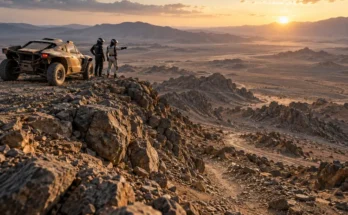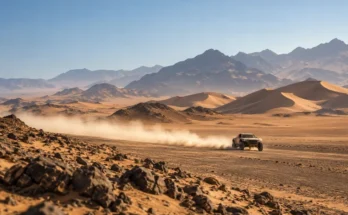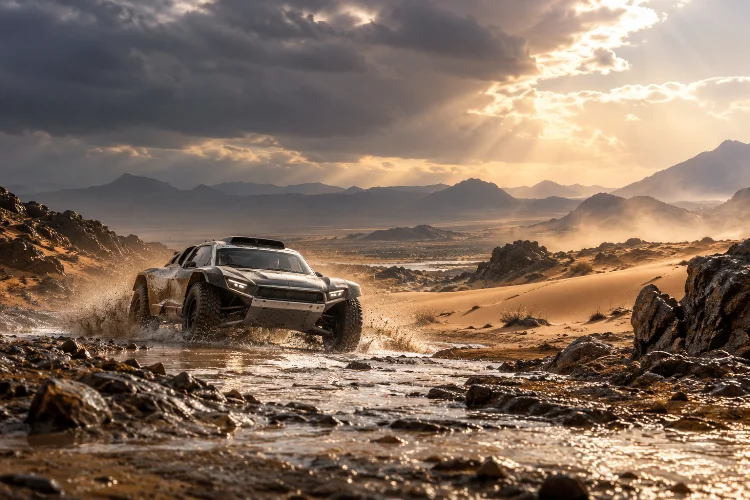
A desert race might sound predictable: heat, sand, dunes, and endless open terrain. The Dakar Rally quickly destroys that assumption.
Within a single stage, competitors can move from firm tracks to soft sand, rocky plateaus, deep dust, wet ground, and dunes whose grip changes dramatically depending on recent weather.
Rain can strengthen sand that was difficult to cross the previous day, while the same rain may wash away small tracks that navigators expected to see.
Those changes make pre-stage planning only the beginning.
Understanding how Dakar teams adapt race plans to changing desert conditions means looking at a constant process of observation and adjustment.
Drivers change pace, navigators reconsider visual references, engineers monitor mechanical stress, and teams revise their expectations for tyres and fuel.
The Dakar rewards crews that arrive with a strong plan but are not emotionally attached to it. When the desert changes, the strategy has to change too.
1. Teams Start With a Plan, Not a Fixed Script
Before a Dakar stage begins, teams already know the planned distance, broad terrain profile, navigation demands, and servicing opportunities.
From that information, they can establish an expected pace and identify where mechanical risk may be higher.
But those plans are never absolute.
The condition of a track can change after dozens of motorcycles and cars have crossed it. Weather may transform the surface overnight, while wind can reshape sections of dunes and obscure existing tracks.
The most successful teams therefore work with flexible scenarios.
Instead of saying, “We will attack for the first 200 kilometres,” the plan is closer to: “We will attack if visibility and grip allow it, then reconsider when the terrain changes.”
That adaptibility is crucial because the Dakar rarely rewards stubbornness.
2. Rain Can Completely Change the Character of Sand
Rain in the desert creates an interesting problem because it does not always make conditions worse.
Sometimes it makes competitors considerably faster.
During Dakar 2025, heavy rain increased the load-bearing capacity of the sand on Stage 7. Dakar organisers noted that the wetter surface also created deeper, clearer tracks, giving motorcycle competitors useful guidance through the terrain.
Tosha Schareina similarly described wet sand during that stage as enjoyable to ride because the rain had improved the terrain.
For teams, this can trigger an immediate change in race pace.
A dune field expected to demand careful momentum management may suddenly provide firmer support. Cars can carry more speed without sinking as deeply, while motorcycles may experience more predictable traction.
Drivers still need caution. Wet sand is not uniform, and transitions between firm and soft sections can appear suddenly.
The strategic lesson is simple: teams race the surface that exists today, not the surface they expected yesterday.
3. The Same Rain Can Make Navigation Much Harder
Weather can improve grip while simultaneously making navigation worse.
Henk Lategan encountered exactly that problem during Dakar 2026 while opening a stage after rainfall.
With no motorcycle tracks to follow, he found that many of the smaller tracks described by the route had been washed away. He called it one of the most difficult stages he had ever opened.
That forces a major strategic adjustment.
A driver may have enough traction to travel quickly, but the navigator needs additional time to interpret headings, roadbook instructions, and subtle terrain features.
Attacking at maximum pace becomes counterproductive if the crew repeatedly overshoots junctions.
Teams therefore reduce speed around uncertain navigation zones and increase it again once the route becomes clearer.
This is why Dakar pace cannot be separated from navigaton. Surface conditions determine not only how much grip a vehicle has, but also how confidently the crew understands where it is going.
4. Soft Sand Requires Momentum Without Excessive Aggression
Soft sand presents almost the opposite problem.
Slow down too much and the vehicle can sink. Attack too aggressively and the driver may overload the drivetrain, overheat components, or arrive at a hidden soft patch carrying too much speed.
Competitors therefore try to maintain controlled momentum.
Michael Docherty described this challenge during Dakar 2025, noting that unexpected soft patches in the dunes could suddenly catch riders out. His response was to remain careful and ride at his own pace rather than blindly increasing speed.
For cars, crews also think about tyre pressure, wheelspin, gear selection, and the angle used to climb dunes.
A driver may select a more direct line when the sand is firm but use a smoother approach when conditions become softer. Excessive wheelspin is especially costly because it creates heat while digging the tyres deeper into the surface.
The goal is not minimum speed.
It is maintaining enough energy to keep moving without creating unnecessary mechanical stress.
5. Dust Can Force an Immediate Pace Reduction
A perfectly dry desert can create its own problem: visibility.
When competitors catch another vehicle, thick dust can hide rocks, corners, ditches, and changes in the track. A driver who was comfortably attacking seconds earlier may suddenly have almost no useful view ahead.
Dania Akeel described this clearly during Dakar 2026. She explained that heavily dusty stages can become a question of risk appetite because closing the gap to another competitor may require driving with dangerously limited visibility.
For teams, the rational response depends on race circumstances.
A driver needing to recover significant time may accept more risk. Someone protecting a strong overall position may wait until the dust clears or a safer passing opportunity develops.
Following distance also becomes strategic.
Moving closer can help prepare an overtake but dramatically reduce visiblity. Dropping slightly farther back may cost seconds while giving the driver enough sight to avoid a major accident.
6. Changing Conditions Alter Tyre and Mechanical Risk
Terrain changes do not only influence driving speed. They change what parts of the vehicle are most vulnerable.
Soft dunes place different loads on a car than rocky tracks. Deep sand can increase drivetrain and cooling stress, while sharp stones threaten tyres, wheels, and suspension components.
Teams therefore reassess mechanical risk throughout a stage.
After leaving sand for a rocky plateau, an aggressive driver may need to reduce speed immediately. A puncture can cost several minutes, and repeated tyre damage can leave the crew with too few spares to maintain the original attack plan.
The reverse can also happen.
If a crew reaches smoother terrain with healthy tyres and no mechanical concerns, the driver may be allowed to increase the pace and recover time lost earlier.
This creates a form of rolling risk management. Every kilometre provides new information about what the vehicle can safely handle.
7. Temperature Changes How Teams Manage the Vehicle
The desert is associated with extreme heat, but Dakar competitors can also experience surprisingly cold conditions.
Earlier Saudi editions have featured rain, low temperatures, and difficult wet stages. Riders have even described freezing conditions on long road sections after competing in heavy rain.
Temperature influences several aspects of race management.
Hotter conditions increase cooling demands and can contribute to tyre and drivetrain stress. Deep sand makes the problem worse because engines work harder while airflow can be reduced at lower speeds.
Crews monitor warning signs carefully.
If coolant or drivetrain temperatue rises unexpectedly, pushing harder may no longer make sense. A short reduction in pace can be much cheaper than stopping with an overheated vehicle.
Drivers also need to manage themselves. Heat, dehydration, and hours of concentration can gradually reduce reaction quality.
Environmental management is therefore part of performance, not merely comfort.
8. Previous Competitors Can Rewrite the Road
Starting position gives different crews very different versions of the same Dakar stage.
The first vehicle onto a route encounters relatively untouched terrain. Later competitors may receive clear tracks that help navigation, but they may also face damaged surfaces created by everyone ahead.
Dunes become cut up. Holes become deeper. Rocks can be exposed or moved into new positions.
Rain can complicate this further.
During Dakar 2025, wet conditions created deeper tracks that sometimes provided useful visual guidance through sandy terrain. But following existing tracks blindly carries its own danger because the competitor who created them may have made a navigation mistake.
Teams therefore treat tracks as information rather than instructions.
A navigator compares them with the roadbook and heading. A driver evaluates whether the physical line still looks safe.
That combination of observation and independent judgement prevents another competitor’s mistake from becoming yours.
9. Race Position Determines How Much Adaptation Is Necessary
Environmental conditions are only half of the calculation.
The overall standings determine how teams respond to them.
A rally leader encountering unexpectedly soft dunes may choose a conservative approach. Losing three minutes could be acceptable if the alternative is becoming stuck and losing thirty.
A competitor who desperately needs time may make the opposite choice.
The same terrain can therefore produce two completely different strategies.
Marathon stages make the trade-off even sharper because servicing opportunities are restricted. FIA cross-country regulations tightly control where assistance can take place, making vehicle preservation especially important when normal team support is unavailable.
Teams continuously combine environmental information with competitive context.
They are not simply asking, “What is the fastest way through these conditions?”
They are asking, “What result do we actually need from these conditions?”
The Dakar desert never behaves like a static racetrack, which is why adaptable teams usually outperform teams that depend on one rigid strategy.
Rain can strengthen sand while erasing navigational tracks. Soft dunes demand momentum, dust reduces visibility, rocky terrain raises puncture risk, and temperature changes the mechanical stress placed on the vehicle.
Even starting position can transform what competitors encounter on the same stage.
Successful Dakar teams respond by constantly adjusting pace, driving lines, navigation confidence, mechanical risk, and overall objectives.
That flexibility is one of rally raid’s most fascinating skills. The next time you follow a Dakar stage, watch how conditions evolve rather than focusing only on speed. The crews that understand the desert fastest are often the ones best positioned to survive it – and eventually win.