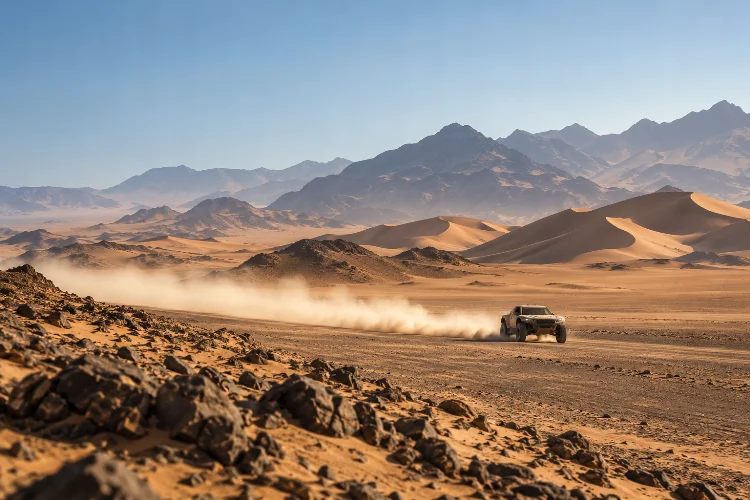
A Dakar Rally vehicle can be incredibly fast and still have almost no chance of winning the race.
That sounds strange in motorsport, where speed normally defines success. But the Dakar is not a short sprint around a predictable circuit. It is a multi-day rally raid covering thousands of kilometres through dunes, rocks, gravel tracks, navigation-heavy terrain, and long liaison sections.
The 2026 edition, for example, covered roughly 8,000 kilometres, including around 5,000 kilometres of timed specials. Over that distance, driving at maximum attack every kilometre can quickly become a losing strategy.
Understanding why pace management matters more than raw speed in the Dakar means looking at the bigger picture.
Drivers have to protect tyres, preserve mechanical components, maintain concentration, follow the roadbook, and decide when the potential reward of pushing harder is actually worth the risk.
The fastest vehicle may dominate a section. The smartest crew tries to remain competitive all the way to the finish.
Dakar Is an Endurance Race Disguised as a Speed Competition
A Dakar special can run for several hundred kilometres, and competitors repeat that challenge day after day.
According to the event’s official format, the rally normally lasts between 10 and 15 days, with timed specials determining the classification alongside any sporting penalties.
That changes the meaning of speed.
On a short circuit, pushing close to the limit for an entire race may be realistic. In rally raid, a competitor must consider what repeated impacts, heat, wheelspin, braking, and high-speed compression are doing to the vehicle.
A slightly slower pace through one rough section might protect the suspension, tyres, steering, and drivetrain. Losing 20 seconds here can be far better than stopping for 15 minutes later.
This is the foundation of good Dakar pace managment: deciding how quickly the vehicle can travel without turning every kilometre into a mechanical gamble.
Maximum Speed and Maximum Sustainable Pace Are Different Things
Dakar teams are not usually asking one simple question: “How fast can we go?”
The more useful question is: “How fast can we go without creating unnecessary risk?”
That difference defines sustainable pace.
Imagine two crews approaching a rocky plateau. One attacks every section at maximum speed and gains 30 seconds. The second backs off slightly, chooses smoother lines, and reaches the next checkpoint without trouble.
If the aggressive crew suffers a puncture shortly afterward, those 30 seconds become meaningless.
This is not theoretical. During Dakar 2026 Stage 1, Nasser Al-Attiyah explained that his crew reduced risk after seeing teammate Sébastien Loeb suffer two punctures.
Al-Attiyah said he could have pushed harder, but instead chose a more cautious approach and still finished only 40 seconds behind the stage winner.
That is pace management working exactly as intended.
Tyre Preservation Can Be More Valuable Than Seconds
Few things change a Dakar strategy faster than a puncture.
Competitors carry spare tyres, but not an unlimited number of them. Once a crew has already used one or two spares, every sharp rock suddenly becomes more threatening.
Driving style therefore has to adapt throughout the stage.
Teams can reduce tyre risk by avoiding violent impacts, choosing cleaner tracks, controlling wheelspin, and resisting the temptation to attack every visible opportunity. The objective is not necessarily to drive slowly. It is to use speed where the risk is acceptable.
Toyota’s Dakar 2024 reporting provided another useful example. Lucas Moraes continued for much of a stage with a slow puncture rather than immediately stopping, before eventually reducing his pace when the tyre deteriorated badly near the finish.
Once punctres enter the equation, raw speed becomes only one variable among many.
The crew now has to calculate whether pushing harder is worth risking another tyre – and potentially the entire stage.
Navigation Rewards Control, Not Blind Aggression
The Dakar is also a navigation contest.
Crews follow a roadbook provided by the organisers, while waypoints and the correct route form part of the sporting challenge. Missing controls or failing to validate enough waypoints can lead to serious penalties under FIA rally-raid regulations.
That means a driver travelling extremely quickly in the wrong direction is accomplishing very little.
High speed also makes navigational corrections more difficult. At 120 or 140 km/h, a missed junction can carry a vehicle hundreds of metres past the correct route before the crew realises something is wrong.
Slowing slightly around complicated roadbook instructions can therefore save minutes.
This is particularly important when opening the road. Without tracks from earlier competitors, the navigator has fewer visual clues.
Henk Lategan described that challenge during Dakar 2026 after having to open a difficult stage with no motorcycle tracks to follow. Small routes had also been affected by rain, making navigaton especially demanding.
A controlled pace gives the navigator more time to interpret terrain and reduces the cost of uncertainty.
Sometimes Losing Time Today Helps Tomorrow
Dakar strategy becomes even more interesting because today’s result can influence tomorrow’s circumstances.
Starting near the front may sound ideal, but being first onto the course can mean navigating without tracks from other competitors. Depending on the terrain and regulations, that can create a significant disadvantage.
This means teams occasionally think beyond the current stage classification.
During Stage 8 of Dakar 2026, Henk Lategan openly discussed trying to avoid winning the stage because he did not want to open the road the following day. He even said that losing time on that stage could be preferable to facing the navigational risk of leading the next one.
It is a perfect example of why pure speed does not explain Dakar strategy.
A five-second gain today could produce a five-minute problem tomorrow.
Experienced teams constantly consider starting order, upcoming terrain, overall classification, and the position of their main rivals before deciding how aggressively to attack.
Marathon Stages Make Mechanical Sympathy Essential
Marathon stages place an even greater premium on controlled driving.
During these sections, outside assistance can be heavily restricted or unavailable. The 2026 Dakar included two marathon stages where competitors could not rely on normal external servicing between stages.
That changes the risk calculation immediately.
A damaged suspension component that mechanics could normally replace in the bivouac becomes much more serious when the crew has to manage the problem themselves.
Drivers therefore have to think several hundred kilometres ahead.
During the 2026 marathon stage, Al-Attiyah explained that he stayed behind Lategan rather than forcing an overtake because conditions were risky and navigation was difficult.
He was willing to accept some lost time in exchange for completing the marathon section without major problems.
That is not conservative racing in the negative sense. It is strategic endurance racing.
Mental Pace Matters as Much as Vehicle Pace
The machine is not the only thing that needs protection.
Dakar drivers and navigators spend hours maintaining intense concentration while processing terrain, roadbook instructions, hazards, vehicle feedback, rival positions, and changing surface conditions.
Fatigue makes mistakes more likely.
A driver who operates at 100 percent intensity for too long may eventually miss a hidden ditch, brake too late, choose the wrong dune line, or fail to notice a developing mechanical problem.
Experienced crews therefore develop a rhythm.
They may attack open terrain where visibility is good, reduce intensity through complicated navigation sections, then increase their pace again when conditions become predictable.
This ability to change effort levels helps competitors remain mentally sharp across an entire rally rather than simply one impressive stage.
The best Dakar crews are not consistantly driving at their absolute maximum. They are consistently choosing the right level of effort.
Overall Classification Changes How Hard a Crew Should Push
Pace strategy is also shaped by the general classification.
A driver who trails the leader by 25 minutes late in the rally may need to take greater risks. A leader with a comfortable advantage has a completely different objective: avoid major problems and protect the gap.
Nasser Al-Attiyah’s successful 2026 Dakar campaign demonstrated this broader approach. At the halfway point, he talked about managing the opening week without major problems before building his advantage, and he ultimately won his sixth Dakar title.
The lesson is simple.
Winning does not require attacking every stage in the same way.
Strong teams identify the moments when additional speed can genuinely change the rally. At other times, finishing safely inside the competitive group may be the better choice.
That ability to separate important attacks from unnecessary ones is one of Dakar’s defining skills.
Raw speed certainly matters in the Dakar, but speed without control can become expensive very quickly.
Successful crews manage pace according to terrain, tyre condition, navigation difficulty, mechanical risk, starting position, fatigue, and the overall classification.
They know when to attack aggressively and, just as importantly, when a few lost seconds are an acceptable price for protecting the rally.
That is why the Dakar is such a fascinating form of motorsport. The fastest driver over one kilometre is not automatically the strongest competitor over thousands.
When you watch the next Dakar stage, pay attention to more than the stopwatch. Look at who protects tyres, manages difficult terrain, chooses the right moments to push, and keeps the vehicle healthy. Those decisions often reveal the real race long before the finish line.