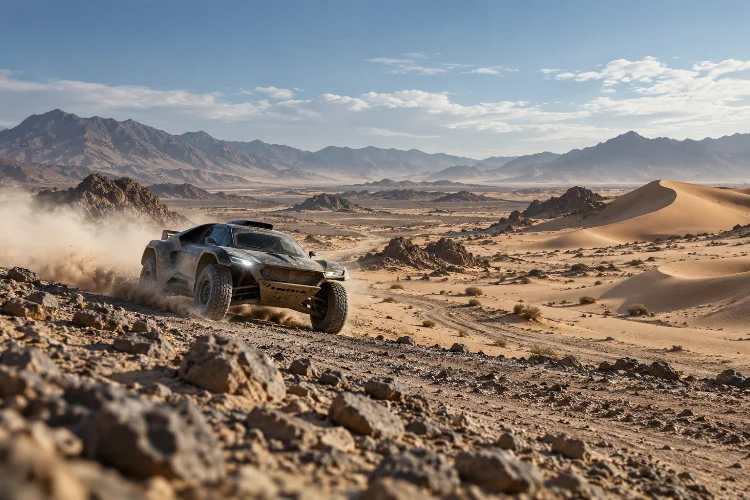
Driving quickly on a smooth road is one thing. Maintaining competitive speed when the surface changes from hard-packed gravel to rocks, soft sand, dunes, dust, and broken tracks within the same stage is something completely different.
That is the daily challenge facing Dakar Rally drivers.
The fastest competitors are not simply brave enough to keep the throttle down. They are constantly reading terrain, adjusting their driving style, protecting tyres, listening to navigation calls, and deciding how much grip is actually available.
During Dakar 2026, Sébastien Loeb described a 480-kilometre stage containing dunes and fast tracks where the leading drivers were operating at very similar speeds, making small mistakes especially costly.
Understanding how elite Dakar drivers maintain speed across unpredictable terrain therefore requires looking beyond outright acceleration.
The real skill is carrying as much speed as the surface safely allows while changing technique almost instantly when the desert changes underneath the vehicle.
1. Elite Drivers Read Terrain Before They Attack It
The first skill is not acceleration. It is observation.
Experienced Dakar drivers continuously read colour, texture, tyre tracks, shadows, rocks, vegetation, and changes in the shape of the ground. These clues help them predict whether the surface ahead is firm, loose, broken, or hiding something more dangerous.
A darker patch of sand might offer different grip from the surrounding surface. A line full of exposed rocks may look shorter but carry much higher puncture risk.
This means drivers rarely treat every visible racing line equally.
Lucas Moraes demonstrated that mindset during the opening stage of Dakar 2026. On a fast but rocky route, he deliberately slowed through rocks and narrow sections because his priority was completing the day cleanly and returning the car in good condition for the longer stage ahead.
Elite speed begins with knowing where not to use all of it.
2. Momentum Is Everything in Soft Sand
Soft sand rewards a very different technique from rocks.
In rocky terrain, reducing speed can protect tyres and suspension. In deep sand, slowing too much can create an entirely new problem: the car may begin sinking and lose the momentum needed to climb or cross soft sections.
Drivers therefore try to keep the vehicle flowing.
That does not mean using full throttle everywhere. Excessive wheelspin can waste energy and dig the tyres deeper into loose ground.
Instead, experienced drivers use smooth throttle inputs and carry enough momentum into climbs to avoid forcing the engine to rescue the vehicle halfway up.
Dunes make line choice especially important.
Henk Lategan noted during Dakar 2026 that only a couple of poor line choices in a full dune stage were enough to cost time against the leaders.
The fastest dune driver is often the one who connects clean lines together rather than producing the most dramatic acceleration.
3. Rock Sections Reward Precision Over Bravery
Rocks completely change the risk calculation.
A Dakar car may be capable of travelling extremely quickly over broken ground, but a sharp impact can puncture a tyre, damage a wheel, or overload suspension components.
Elite drivers therefore choose where to place the car with extreme care.
The obvious straight line is not always fastest over an entire stage. Moving slightly off line to avoid a particularly sharp rock may cost half a second while preventing several minutes of tyre-changing time.
Toby Price provided a good example during Dakar 2026 when he admitted taking more risk than he ideally wanted through rocky sections during a strong stage performance. His tyres survived, but his comments showed how closely speed and mechanical risk are connected.
Experienced competitors develop a consistant rhythm through rocks.
They brake before the biggest impacts, release unnecessary steering load when crossing obstacles, and accelerate when the surface becomes safer again.
That controlled approach allows them to remain fast without turning every kilometre into a mechanical lottery.
4. Smooth Inputs Preserve Speed When Grip Keeps Changing
Aggressive steering and throttle inputs can feel fast.
On unpredictable surfaces, they often create instability.
A sudden throttle application can produce wheelspin when the car moves from firm ground onto loose sand. Abrupt steering can overload the outside tyres when grip unexpectedly increases.
Elite Dakar drivers therefore tend to make very deliberate inputs.
Smooth steering keeps the chassis balanced. Progressive throttle application helps the driver feel how much traction is available. Controlled braking reduces the chance of locking wheels over loose or broken terrain.
This becomes especially useful when the surface changes several times through one sequence.
The driver may approach a corner on hard ground, cross a sandy section at the apex, then accelerate onto rocks at the exit.
There is no single grip level.
The driver constantly adjusts.
This is one reason spectacular-looking driving is not always the fastest driving. A car moving calmly can be travelling extremely quickly because the driver is avoiding corrections that waste momentum.
5. Dust Forces Drivers to Manage Visibility Like Grip
Sometimes the road surface is not the biggest problem.
Seeing it is.
Catching another competitor can place a Dakar driver inside an enormous cloud of dust. Rocks, holes, corners, and even the vehicle ahead may become difficult to see.
The instinct is to close the gap and attack.
Elite drivers calculate whether that risk makes sense.
Dania Akeel explained during Dakar 2026 that heavily dusty stages can become as much about risk appetite as pure driving ability. Closing the gap in another competitor’s dust may require accepting hazards that simply cannot be seen clearly.
Sébastien Loeb experienced the same issue during the 2026 prologue. After catching Henk Lategan’s dust, Loeb lost his line several times and gave away valuable seconds.
Good visiblity management may mean temporarily dropping back.
Once cleaner air appears, the driver can return to normal pace rather than gambling on obstacles that cannot be seen.
6. Navigation and Driving Speed Have to Match
A Dakar driver cannot maintain speed independently of the navigator.
The faster the car travels, the less time the crew has to process the next roadbook instruction.
When navigation is straightforward, drivers can commit harder. When the route contains ambiguous tracks, hidden waypoints, or difficult CAP changes, reducing pace briefly may actually improve the overall stage time.
That is because one wrong navigation decision can erase kilometres of fast driving.
Loeb’s 480-kilometre Stage 8 in Dakar 2026 showed exactly that. After spending most of the stage chasing competitive times, a navigation mistake near the finish cost him an estimated two to three minutes.
Elite drivers therefore respond immediately when the co-driver sounds uncertain.
They create enough seperation between speed and risk for the navigator to confirm the correct route, then accelerate again once confidence returns.
The stopwatch rewards average progress toward the finish, not maximum speed in the wrong direction.
7. Suspension Performance Allows Drivers to Carry More Speed
Driver technique is only part of the equation.
The vehicle must give the driver confidence to attack unpredictable terrain. Modern Dakar prototypes use extremely sophisticated long-travel suspension.
The Ford Raptor T1+, for example, uses independent double-wishbone suspension with adjustable external-bypass dampers and up to 350 mm of wheel travel. Ford developed the system specifically for control and durability over extreme rally-raid terrain.
That suspension allows drivers to maintain higher speed across bumps that would force a normal vehicle to slow dramatically.
But drivers still need to understand the car’s limits.
Nani Roma highlighted this relationship during Dakar 2026 after a demanding dune stage. He credited a strong setup with allowing him to push close to the limit while opening the route.
A good Dakar driver effectively works with the suspension rather than simply relying on it.
They know which compressions the car can absorb and which impacts require a lift.
8. Pace Has to Change Before the Terrain Forces It To
Reactive drivers slow only after conditions become difficult.
Elite drivers anticipate the change.
If the navigator warns that a fast track will soon enter rocks, the driver begins preparing before reaching them. If soft dunes are approaching, the driver builds the momentum and gear choice needed before entering the sand.
This forward planning reduces abrupt transitions.
It also helps prevent mistakes caused by arriving at unfamiliar terrain with the wrong amount of speed.
Michael Docherty described settling into a smooth pace after an early mistake during a Dakar 2026 dune stage. Rather than trying to recover everything immediately, he concentrated on maintaining rhythm to the finish.
That idea applies just as strongly in cars.
Great Dakar pace rarely feels like repeated acceleration followed by emergency braking. It is a continuous flow where speed rises and falls according to what the driver expects several seconds ahead.
9. Elite Drivers Accept That Maximum Speed Is Not Always Useful Speed
One of the biggest differences between Dakar and short-format racing is how drivers define useful speed.
Maximum attack might gain a few seconds across a smooth section.
If it overheats tyres, increases fatigue, creates a puncture, or reduces the driver’s ability to react to the next terrain change, the gain disappears quickly.
Loeb’s comments during Dakar 2026 captured how close the modern competition has become. When everyone is attacking at similar speeds, differences in track conditions and mistakes can matter more than finding another tiny amount of raw pace.
That makes pace managment a genuine performance skill.
Drivers attack where they can create meaningful time. They protect the vehicle where risk becomes disproportionately high.
Across hundreds of kilometres, that selective aggression creates a higher average speed than blindly driving at maximum intensity everywhere.
Elite Dakar drivers maintain speed across unpredictable terrain by constantly adapting rather than trying to drive every kilometre the same way.
They preserve momentum through soft dunes, use precision over rocks, smooth their inputs as grip changes, manage dust carefully, and reduce pace when navigation becomes uncertain.
Vehicle setup and long-travel suspension give them the tools to move quickly, but judgement determines how those tools are used.
That is why Dakar speed is so different from a simple top-speed contest.
The next time you follow a stage, watch how the fastest crews change rhythm as the landscape changes. Their real advantage is not always how quickly they accelerate. It is how little unnecessary speed they lose while moving from one completely different type of terrain to another.