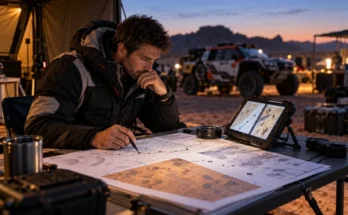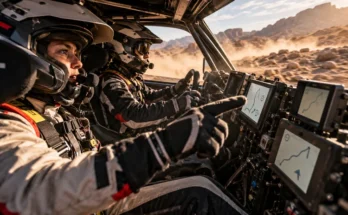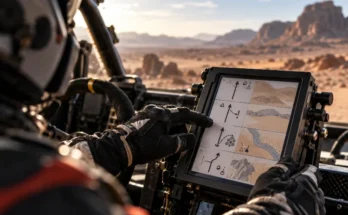
Missing a navigation point in the Dakar Rally can turn a perfect stage into chaos surprisingly quickly.
One moment, a crew is attacking at competitive pace. The next, the roadbook distance no longer matches the terrain, the expected track has disappeared, and the waypoint indicator refuses to confirm anything.
Continuing at full speed can make the situation worse, but turning around immediately is not always the smartest choice either. That is why experienced Dakar crews develop a clear recovery process.
Modern rally-raid navigation combines electronic roadbooks, CAP headings, odometer readings, terrain references, and different waypoint types.
Under current FIA rules, some waypoints only provide GPS guidance after competitors enter a defined opening radius, meaning crews still need to navigate themselves into the correct area.
Understanding how drivers recover after missing a Dakar Rally navigation point therefore involves much more than simply making a U-turn.
The crew first has to recognise the mistake, establish where it happened, and find the quickest safe way back into the correct navigation sequence.
1. The First Challenge Is Realising Something Is Wrong
The longer a crew continues after a navigation mistake, the more expensive recovery becomes.
Experienced navigators therefore look for small warning signs before the error becomes obvious. The trip distance might stop matching the roadbook, the expected terrain feature may never appear, or the CAP heading could begin moving away from what the next note suggests.
Another warning is the waypoint itself.
Under FIA rules, navigation equipment only directs competitors toward certain waypoint types after specific conditions are met. A masked waypoint, or WPM, for example, has an 800-metre opening radius under the 2026 regulations.
If the crew expects GPS assistance but nothing appears, that can indicate they have approached the area incorrectly.
The important skill is recognising uncertainty early rather than insisting that the current route must be right.
In Dakar navigaton, confidence is useful. Stubborn confidence can be extremely expensive.
2. Crews Return to the Last Confirmed Roadbook Reference
Once a crew knows something is wrong, the navigator needs a reliable reference point.
The best question is usually not, “Where are we now?”
It is, “Where were we last definitely correct?”
That may be a distinctive junction, dry riverbed, CAP change, building, danger note, or previously validated waypoint.
From there, the crew can reconstruct what happened.
For example, if the last confirmed instruction was at kilometre 214.30 and the current trip shows 219.80, the navigator knows the mistake happened somewhere within approximately 5.5 kilometres.
That narrows the search considerably.
Crews can then compare partial distance, total distance, roadbook drawings, and terrain rather than randomly following tracks.
This last-confirmed-point method creates a stable referance when the surrounding desert suddenly stops making sense.
3. Distance and CAP Help Rebuild the Route
After identifying the last correct instruction, navigators use distance and CAP headings to work out where the wrong decision occurred.
Suppose the roadbook says to leave a track after 2.4 kilometres and continue at CAP 260.
The crew travels 3 kilometres and suddenly notices its heading is closer to CAP 220.
That mismatch immediately gives useful information.
Instead of searching everywhere, the crew can retrace the section while looking specifically for the point where the intended 260-degree route separated from the track they followed.
CAP becomes particularly valuable in open terrain because visual features can be confusing.
Dunes, plains, and desert tracks often look similar from one area to another. A heading provides an independent clue that does not depend on how convincing a tyre track appears.
Still, CAP should never be used alone.
The best recovery combines heading, distance, terrain, roadbook notes, and waypoint behaviour.
4. Other Competitors’ Tracks Can Help – But Can Also Make Things Worse
When a crew becomes lost, seeing tyre tracks can feel reassuring.
Unfortunately, those tracks may belong to another lost competitor.
This creates one of Dakar’s classic navigation traps.
Several vehicles can make the same mistake because the second driver assumes the first must know where they are going. Soon there are enough incorrect tracks to make the wrong route look more convincing than the correct one.
Daniel Sanders has previously described the importance of checking the roadbook rather than simply following other competitors’ lines when navigation becomes tricky.
Experienced navigators therefore treat tracks as evidence, not instructions.
If tracks agree with CAP, roadbook distance, terrain features, and the expected waypoint direction, they become useful confirmation.
If everything except the tyre marks says the route is wrong, the roadbook should carry more weight.
That discipline becomes especially important when several competitors are circling the same missing point.
5. Sometimes the Fastest Recovery Means Turning Around
Turning around feels painful during a timed Dakar stage.
Every second spent travelling backward seems like time thrown away.
But continuing on the wrong route can turn a 60-second mistake into a 15-minute disaster.
Carlos Sainz experienced exactly how frustrating waypoint searches can become during Dakar 2026. On Stage 9, he described a difficult navigation section where he and other competitors were repeatedly turning around while trying to find the route.
The following day brought another example. Sainz said his crew could not find a waypoint despite searching extensively, costing roughly 15 minutes.
Henk Lategan also reported getting lost twice and missing waypoints during Stage 10.
These examples show why crews need to reasses quickly.
Once the evidence says a route is wrong, going farther rarely improves the situation.
A controlled U-turn toward a known roadbook reference is often much faster than continuing to gamble.
6. Waypoint Type Changes the Recovery Decision
Not every missed waypoint carries the same sporting consequence.
That matters strategically.
The current FIA Cross-Country Rally Sporting Regulations distinguish between several waypoint types, including WPE, WPN, WPM, WPS, WPC, and WPP. They also assign different opening and validation radii.
The penalties can differ dramatically.
Under the published 2026 penalty table, missing most navigation waypoints carries a 15-minute penalty, while missing a WPN – Navigation Waypoint – carries 60 minutes.
WPNs are specifically used to stop competitors bypassing challenging navigation or terrain such as dune sections.
That makes waypoint awareness part of recovery strategy.
If a crew suspects it has missed a particularly important waypoint, spending several minutes trying to recover it may still be considerably cheaper than simply continuing.
The navigator therefore needs to understand not only where the point should be, but what type of point it is.
7. The Crew Must Avoid Creating a Second Mistake
One navigation error is manageable.
Two consecutive errors can destroy a stage.
This often happens when frustrated crews rush their recovery.
The navigator may jump forward through roadbook notes too quickly, adjust the odometer incorrectly, or mistake a later track for the one they originally missed. The driver may also attack aggressively in an attempt to recover lost time immediately.
That combination creates more risk.
Professional crews try to reset the navigation sequence first.
They confirm the correct note, restore the trip reference where necessary, establish the next CAP, and verify what terrain should appear ahead.
Only when the information makes sense again does normal racing pace return.
This sounds slow, but it prevents confusion from spreading through the next several kilometres.
The best recovery is not necessarily dramatic.
It is consistant and methodical.
8. Calm Communication Matters as Much as Navigation Skill
Getting lost creates pressure inside the cockpit.
The driver wants an immediate direction. The navigator is trying to understand several conflicting pieces of information. Meanwhile, the stopwatch keeps running.
Arguments do not make the waypoint easier to find.
Strong driver-navigator partnerships therefore use very direct communication when recovery begins.
The navigator might tell the driver to slow down, return to a specific kilometre reference, hold a certain CAP, or search for one distinctive track.
The driver then executes that instruction without adding unnecessary complexity.
Once the correct route is found, the crew mentally resets.
This matters because frustration can lead to excessive speed and another mistake immediately afterward.
Successful Dakar crews understand that five minutes lost cannot be recovered in the next five kilometres.
They return to their planned pace and let the rest of the stage create opportunities naturally.
9. Sometimes Navigation Recovery Decides the Entire Dakar
Navigation mistakes are not always minor inconveniences.
They can decide championships.
The 2026 Dakar motorcycle competition produced an extraordinary example. Ricky Brabec was leading close to the finish of the final stage when a navigation error about seven kilometres from the end sent him off the correct route.
He had to complete an additional loop of roughly three kilometres. Luciano Benavides ultimately won the rally by only two seconds – the smallest winning margin in Dakar history.
That example demonstrates why recovery speed matters so much.
Once a mistake happens, there is no benefit in thinking about the time already lost.
The only useful question is how quickly the competitor can re-establish the correct route.
A calm 30-second recovery can preserve a rally.
A panicked five-minute search can end one.
Missing a Dakar navigation point does not automatically ruin a stage. Poor recovery often causes more damage than the original mistake.
Experienced crews recognise warning signs early, return mentally or physically to the last confirmed roadbook instruction, compare distance with CAP headings, and resist blindly following other competitors.
They also understand the waypoint type and the potential penalty before deciding how much time should be invested in finding it.
Most importantly, they stay calm.
The next time a Dakar competitor suddenly turns around or slows dramatically in open desert, do not assume the crew has completely lost control. They may be carrying out a structured recovery designed to stop one navigation error from becoming several.
In rally raid, finding the correct route quickly after getting lost can be almost as important as never getting lost at all.