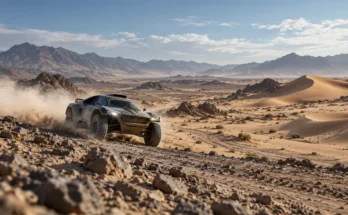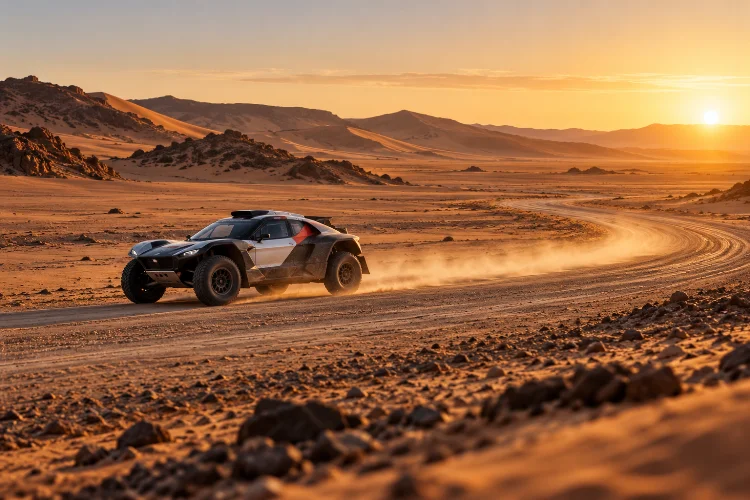
A Dakar Rally car sliding wildly through the desert can look incredibly fast. The problem is that dramatic driving and genuinely fast stage times are not always the same thing.
Dakar competitors race for hundreds of kilometres across rocks, sand, dunes, fast tracks, narrow passes, and navigation-heavy terrain. Over that distance, every unnecessary correction costs something.
Excessive wheelspin wastes momentum, aggressive steering increases tyre load, hard braking heats components, and repeated impacts raise the chances of mechanical trouble.
That is why smooth driving often produces faster Dakar Rally stage times.
During Dakar 2026, Mitch Guthrie described his first Ultimate-class stage victory as a clean day with accurate navigation, no punctures, and a car that simply kept moving. That idea captures one of rally raid’s biggest lessons.
The fastest crews are rarely trying to create maximum drama. They are trying to preserve speed with the fewest interruptions possible.
1. Smooth Driving Protects Momentum
Momentum is one of the most valuable resources in rally raid.
Every time a driver brakes harder than necessary, makes a large steering correction, or produces excessive wheelspin, the vehicle loses energy that has to be rebuilt through acceleration.
That matters especially in dunes.
A smooth driver approaches a climb with enough speed, keeps throttle delivery progressive, and tries to carry momentum over the crest. A more aggressive driver may attack harder but create wheelspin, dig the tyres deeper into the sand, and lose speed halfway up.
The same principle applies on flowing gravel tracks.
Rather than braking late and accelerating violently out of every corner, elite drivers often connect one corner to the next with fewer abrupt changes in speed.
The car may look calmer, but its average velocity can be higher because less time is spent recovering from unnecessary inputs.
That is the key difference between maximum effort and maximum progress.
2. Fewer Steering Corrections Mean Less Lost Speed
A steering correction may appear almost insignificant.
Across a 400-kilometre stage, hundreds of them add up.
When the driver enters a corner too aggressively, the car may slide wider than expected. The driver then has to reduce throttle, counter-steer, and wait for the tyres to regain grip.
A smoother approach uses a cleaner initial line.
The car stays more balanced, the tyres remain within a more predictable grip range, and power can be applied earlier.
This becomes particularly important when terrain is unpredictable.
Loose gravel may suddenly become harder ground. A sandy section may appear in the middle of a fast track. Aggressive steering leaves less margin when grip changes suddenly.
Smooth inputs give the driver time to react without upsetting the chassis.
That consistant balance is one reason experienced Dakar drivers can appear surprisingly relaxed while still producing extremely competitive times.
3. Smooth Throttle Inputs Reduce Wheelspin
Wheelspin looks fast because the engine is working hard and sand or gravel is flying everywhere.
But spinning tyres are not always moving the car forward efficiently.
In loose terrain, excessive wheelspin converts useful engine power into heat and displaced surface material.
Smooth throttle application lets the tyre build traction more progressively.
That is particularly important in deep sand, where aggressive throttle can cause the tyres to dig downward rather than push the vehicle forward.
Controlled throttle also reduces shock through the drivetrain.
Differentials, driveshafts, gearbox components, and wheel assemblies already experience severe load changes during Dakar competition. Sudden traction after heavy wheelspin can produce additional mechanical stress.
So smooth acceleration provides two advantages at once: better forward movement and lower drivetrain punishment.
Over one acceleration zone, the difference may be tiny.
Over several hours, it can become meaningful.
4. Tyre Preservation Can Save Minutes
Tyres are one of the strongest arguments for controlled Dakar driving.
Nasser Al-Attiyah demonstrated this during Stage 1 of Dakar 2026. After seeing teammate Sébastien Loeb suffer two punctures, Al-Attiyah deliberately became more cautious rather than continuing at maximum attack. He still finished only 40 seconds behind the stage winner.
That is an important comparison.
A driver might gain several seconds by attacking a rocky section harder. One puncture can easily erase that advantage and much more.
Smooth drivers reduce unnecessary tyre load by avoiding violent steering, harsh impacts, excessive wheelspin, and poor lines through rocks.
Lucas Moraes used a similar philosophy during the same Dakar. On a fast but rocky opening stage, his goal was to complete a clean run and return the car in good condition for the longer day ahead, deliberately reducing speed through rocks and narrow passages.
Avoiding punctres is not simply conservative driving.
It is stage-time management.
5. Smooth Pace Makes Navigation Easier
Dakar drivers do not race independently of their navigators.
The faster the car travels, the less time the co-driver has to read roadbook notes, check distances, confirm headings, and communicate the next instruction.
Driving beyond the crew’s navigation rhythm creates problems.
Sébastien Loeb highlighted the cost of small mistakes during Dakar 2026. After chasing competitive times throughout a 480-kilometre stage, a navigation error near the finish cost his crew roughly two to three minutes.
That is more time than drivers often gain through extremely aggressive driving across many kilometres.
Smooth pace gives the co-driver a more predictable platform from which to work.
The driver brakes where expected, follows cleaner lines, and avoids creating unnecessary workload just before complicated roadbook instructions.
This does not mean travelling slowly.
It means matching vehicle speed to the amount of information the crew can process accurately.
A clean navigation rhythm often produces a higher true average speed than sprinting between mistakes.
6. Mechanical Sympathy Keeps the Car Fast Longer
Dakar stage time is not determined only by how quickly the vehicle moves when everything works perfectly.
It also depends on how much time is lost when things stop working.
Every harsh landing, sudden drivetrain shock, or unnecessary collision with terrain adds stress to the vehicle.
Smooth driving reduces those loads.
Instead of hitting every compression at maximum speed, experienced competitors lift slightly when the potential gain is smaller than the mechanical risk.
Nasser Al-Attiyah showed this broader mindset during the 2026 marathon stage. He accepted losing time rather than forcing a risky pass in difficult navigation and terrain, prioritising a clean completion of the stage.
The logic is simple.
Five seconds gained before a suspension failure has no value.
Mechanical sympathy allows the vehicle to maintain competitive performance throughout the stage rather than producing brilliant speed followed by a repair stop.
Smoothness therefore becomes part of reliability.
7. Clean Driving Reduces Driver Fatigue
Aggressive driving is mentally and physically expensive.
Every slide needs correction. Every late braking moment demands intense concentration. Every unstable landing forces the driver to react quickly.
Multiply that by several hours and fatigue begins to matter.
Smooth driving reduces unnecessary workload.
The driver still operates near the competitive limit, but the car spends less time in situations requiring emergency corrections.
This helps preserve concentration late in the stage.
That matters because Dakar mistakes often appear after hours of racing, when the driver is tired and the roadbook still demands accuracy.
Michael Docherty described exactly this type of rhythm during Dakar 2026. After an early mistake, he chose to maintain a smooth pace to the finish and still produced an extremely strong performance in the dunes.
Sometimes the smartest response to a mistake is not attacking harder.
It is restoring flow.
8. Smooth Driving Keeps the Chassis Balanced
Modern Dakar suspension systems are extremely capable, but drivers still need to work with them.
A balanced car places more predictable loads on all four tyres.
Hard braking throws weight toward the front. Sudden throttle shifts it rearward. Abrupt steering adds lateral load. Combining all three aggressively can overwhelm the available grip.
Smooth drivers manage those transfers gradually.
They may begin braking slightly earlier, release the brake progressively as they turn, and feed power back in once the chassis is settled.
This creates a more stable platform across loose or broken terrain.
The result is often greater confidence.
When the driver knows the vehicle will respond predictably, they can maintain more speed through long sections rather than constantly reducing pace because the car feels unstable.
Smooth driving is therefore not passive.
It is a deliberate way of keeping the suspension and tyres inside their most useful operating window.
9. Clean Stages Often Beat Spectacular Ones
One of the clearest Dakar examples came from Mitch Guthrie’s Stage 3 victory in 2026.
He did not describe some extraordinary all-or-nothing attack. Instead, Guthrie emphasised accurate navigation, no flat tyres, a well-performing car, and simply continuing to move throughout the day.
Mattias Ekström made a similar point after winning the 2026 prologue. He described completing a clean stage and felt the crew had reached the maximum performance available to them.
That is what elite Dakar smoothness looks like.
It is not slow.
It is removing wasted actions.
Fewer mistakes, fewer unnecessary slides, fewer tyre problems, and fewer moments where the vehicle has to recover from instability can create a surprisingly large advantage.
By contrast, Toby Price acknowledged taking more risk than he would have preferred through rocks during Stage 12. The tyres survived and the result was strong, but his comments illustrated how quickly extra aggression increases exposure to problems.
10. Average Speed Matters More Than Momentary Speed
The stopwatch does not care which driver looked fastest over one dramatic dune.
It measures how long the entire stage took.
That means average progress matters far more than isolated bursts of speed.
A driver travelling slightly slower through dangerous rocks may be quicker overall if they avoid stopping for a tyre change. A smoother dune line may beat a spectacular one if it preserves momentum over several kilometres.
The same applies to navigation.
Loeb noted during Dakar 2026 that leading crews were often travelling at very similar speeds when attacking, making mistakes and changing track conditions major factors in the final results.
When raw pace is already close, effeciency becomes decisive.
The competitor who wastes the least time can beat the competitor who occasionally reaches the highest speed.
That is why Dakar driving rewards flow more than drama.
Smooth driving produces fast Dakar stage times because it protects the things that actually determine average speed.
Progressive throttle preserves traction, clean steering protects tyres, controlled braking keeps the chassis balanced, and accurate line choice reduces mechanical punishment.
A predictable pace also gives navigators more time to work and helps drivers conserve concentration across long stages.
None of this means elite competitors are driving cautiously all the time. They still attack extremely hard when conditions allow it.
The difference is that their aggression is controlled. When you watch the next Dakar stage, look beyond the biggest slides and highest-speed shots.
Pay attention to the crews that simply keep moving without punctures, corrections, navigation mistakes, or mechanical stops. Very often, that quiet smoothnes is exactly what makes them fast.