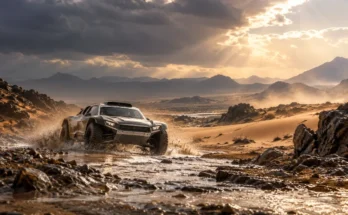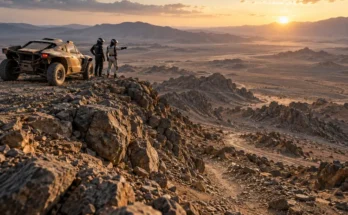
The Dakar Rally looks chaotic from the outside. Cars, bikes, and trucks blast across dunes, rocky tracks, open desert, and fast gravel while crews chase the clock for hours at a time.
Behind that spectacle, however, successful Dakar Rally teams operate with remarkable discipline.
Winning a long stage is rarely about driving at maximum speed from the first kilometre to the last. Teams must decide when to attack, when to protect the vehicle, how much risk to accept on rocky terrain, and whether a few seconds gained today could create a much bigger problem tomorrow.
That challenge becomes clearer when you consider the scale of the event. The 2026 Dakar covered roughly 8,000 kilometres, including about 5,000 kilometres of timed special stages, while competitors also faced marathon formats where normal team assistance was restricted.
Understanding how Dakar Rally teams build winning strategies across long stages therefore means looking beyond outright speed. The real contest combines pace, navigation, reliability, teamwork, energy management, and constant risk calculation.
1. The Fastest Pace Is Not Always the Winning Pace
In a conventional circuit race, pushing harder often means going faster. Dakar strategy is more complicated.
A driver may gain 20 seconds by attacking aggressively through a rocky section but lose several minutes after puncturing a tyre. Worse, suspension or drivetrain damage can effectively destroy an entire rally.
That is why elite crews develop what could be called a sustainable race pace. They drive quickly enough to remain competitive while leaving a margin for unexpected rocks, hidden drops, soft sand, and navigational corrections.
Toyota’s Dakar reports have repeatedly illustrated this trade-off. During the 2023 event, Henk Lategan described suffering early punctures after pushing too quickly over rocky terrain. With spare tyres disappearing, the crew had to switch from attacking to survival mode.
That is classic Dakar mathematics: losing seconds voluntarily can sometimes prevent losing hours involuntarily.
2. Navigation Can Matter More Than Raw Speed
Speed means very little when a crew is heading in the wrong direction.
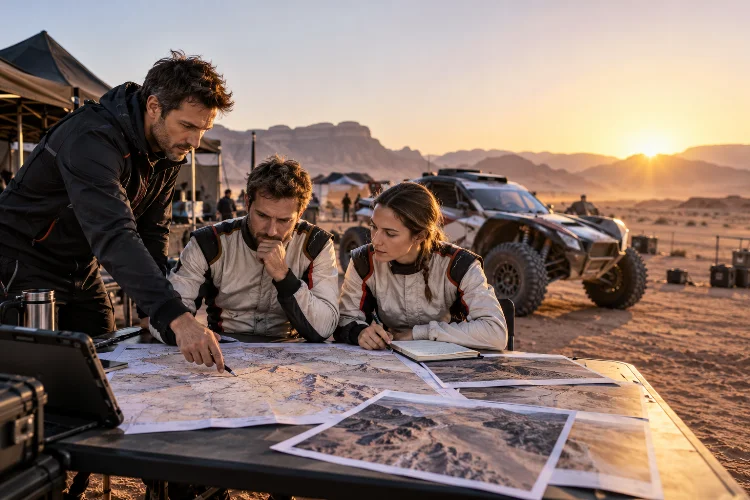
Dakar navigation relies heavily on the roadbook, waypoints, headings, terrain interpretation, and communication between driver and navigator.
The official Dakar roadbook system is specifically designed to make navigation a central part of the competition rather than allowing teams to study every route far in advance.
A small navigaton mistake can be extremely expensive. Overshooting a hidden junction, following the wrong valley, or failing to validate a waypoint may cost far more time than a slightly conservative driving pace.
The challenge becomes even greater when a crew starts near the front. There may be few tyre tracks to follow, meaning the navigator has to identify the route without visual clues created by earlier competitors.
During Dakar 2026, organisers specifically highlighted stages where cars could not rely on motorcycle tracks because categories followed separate routes. That placed additional pressure on navigators to make accurate decisions independently.
For winning teams, navigation is therefore not separate from speed. It determines how much of that speed can actually be used safely.
3. Teams Break Long Stages Into Smaller Problems
A 400-kilometre special can feel overwhelming if treated as one continuous sprint.
Top crews effectively divide the stage into sections according to terrain, navigation difficulty, fuel considerations, tyre risk, and expected opportunities to attack.
Imagine a stage beginning with sharp rocks, moving into fast open tracks, and finishing with large dunes.
The fastest strategic approach may involve protecting the tyres during the first section, increasing pace on the smooth middle portion, and then preserving enough concentration and mechanical condition for the dunes.
This approach also helps drivers manage mental fatigue.
Instead of thinking about hundreds of kilometres remaining, crews focus on the next waypoint, terrain transition, or navigational instruction. That keeps communication precise and reduces the temptation to chase competitors emotionally.
The strategy is adjusted constantly. If another contender stops with a puncture, for example, the crew may no longer need the same level of aggression.
Dakar racing is strategicly flexible by nature.
4. Tyre Management Can Decide an Entire Stage
Tyres are among the most valuable resources inside a Dakar vehicle.
Rocky terrain, high temperatures, heavy vehicles, and aggressive driving loads create an environment where punctures are an everyday threat. Carrying spare tyres provides protection, but the supply is obviously limited.
Once those spares disappear, strategy changes dramatically.
Toyota provided a striking example during the 2021 Dakar when Giniel de Villiers suffered four punctures despite carrying only three spare tyres.
The crew eventually needed assistance from another competitor and later faced the problem of beginning the following stage with worn tyres.
That shows why tyre strategy begins before a puncture occurs.
Drivers select lines carefully through rocky areas, avoid unnecessary wheelspin, and sometimes reduce speed over surfaces where the risk-to-reward ratio becomes poor. After one or two punctres, the acceptable level of risk can change immediately.
Saving a tyre may not look dramatic on television, but it can preserve a podium campaign.
5. Marathon Stages Turn Reliability Into a Tactical Weapon
Normal Dakar bivouacs give professional teams access to mechanics, tools, spare parts, engineers, and detailed inspections.
Marathon stages change that equation.
Under Dakar marathon rules, competitors can face periods without their normal assistance crews. The 2026 format also featured refuge-style stages in which participants stayed in minimalist desert bivouacs and managed their vehicles with heavily restricted outside support.
Suddenly, mechanical preservation becomes even more valuable.
A driver who attacks every rock on the first half of a marathon could arrive at the overnight stop with damaged suspension, a bent wheel, or another problem that cannot be repaired as easily as it could at the main bivouac.
Teams therefore think beyond the stopwatch.
They may deliberately sacrifice a small amount of stage time to deliver a healthier vehicle into the following day.
Nasser Al-Attiyah has described exactly this type of approach in past Dakar campaigns, emphasizing finishing stages cleanly and avoiding unnecessary problems when protecting an overall advantage.
Reliability becomes performance.
6. Driver and Navigator Communication Must Be Almost Automatic
The driver sees terrain. The navigator sees the route.
Neither can perform at Dakar-winning level without the other.
During high-speed sections, navigators must deliver roadbook instructions early enough for drivers to react but not so early that instructions become confusing.
Drivers also need to explain what they are seeing when the physical terrain does not appear to match the roadbook perfectly.
This communication becomes especially important after mistakes.
If the crew misses a junction, frustration wastes time. Successful crews quickly confirm their position, agree on the correction, and move forward rather than arguing about who caused the error.
Toyota driver Henk Lategan previously noted how improved communication with navigator Brett Cummings helped the pair become more comfortable with Dakar navigation.
The best partnerships gradually develop a shared rhythm where information is processed almost instinctively.
7. Race Position Changes the Strategy
Dakar strategy also depends on the overall classification.
A driver chasing the leader by 20 minutes may accept risks that make little sense for someone holding a comfortable advantage.
The leader’s objective can shift from winning individual stages to controlling losses, avoiding mechnical problems, and reaching the finish consistently. The challenger, meanwhile, may need to attack sections where the terrain suits the vehicle particularly well.
Stage position matters too.
Opening the road can make navigation more difficult because there are fewer tracks to follow. Starting farther behind may offer useful clues, although dust and traffic can create different disadvantages.
This creates a fascinating strategic balance. Winning today’s stage may influence tomorrow’s starting circumstances, so teams often think several steps ahead rather than treating each day independently.
Dakar is therefore closer to a two-week endurance chess match than a sequence of unrelated races.
8. Teams Continuously Recalculate Risk
Before every stage, engineers and crews can develop a detailed plan.
The desert rarely follows it.
Weather changes the sand. Previous vehicles expose rocks. Dust reduces visibility. A puncture removes a spare tyre. A rival suddenly gains or loses significant time.
Winning teams respond rather than panic.
They continually compare potential reward against potential consequences. If the car feels abnormal, the driver may back off. If navigation becomes confusing, confirming the roadbook may be better than following another competitor blindly.
If rivals encounter trouble, protecting the vehicle may suddenly become the smartest attack.
This adaptability is one of the biggest differences between simply being fast and being capable of winning the Dakar Rally.
The Dakar Rally rewards speed, but it rewards judgement even more.
Across long stages, successful teams constantly balance navigation, tyres, vehicle reliability, terrain, race position, driver concentration, and overall classification.
Sometimes the correct decision is to attack. At other moments, backing off for a few kilometres can protect hours of work built across the entire rally.
That is why Dakar champions rarely win through one spectacular performance alone. They build competitive pace day after day while limiting costly mistakes and keeping the vehicle alive.
The next time you watch a Dakar stage, look beyond the stage winner. Watch how leading crews manage rocks, respond to navigation problems, protect their equipment, and change pace throughout the rally. That is where much of the real strategy is happening.